





Samsung Smart Glasses: Why the Phone-First Approach Makes Sense
Samsung smart glasses arrived last week at Galaxy Unpacked in London with a notably smaller promise than most of this category has tried to make. No liberation from your phone. No ambient computing revolution. The phone stays essential; the glasses reduce the friction of reaching for it.
That framing, stated plainly in Samsung's launch press release: "Mobile phones remain at the center of connected experiences," is either a genuine product philosophy or an honest admission of where the hardware is today. Probably both. The more important question is whether lowering the category's ambition actually raises its odds of working.
The evidence from Samsung's own product choices, and from independent research on why camera-equipped glasses have struggled socially, suggests the answer is conditional: the strategy is sound, the ecosystem dependency is real, and the one problem Samsung hasn't solved is the one that has stalled predecessors before.
One sourcing note worth flagging upfront: almost everything known about this product comes from Samsung press materials, with GSMArena largely summarizing those announcements. The privacy analysis draws on peer-reviewed research. Samsung's product claims haven't been independently tested, and that gap matters when weighing what follows.
Samsung's audio-first design, display-free hardware, and phone-dependent processing form a coherent response to how camera glasses have failed socially and commercially before. Fashion partnerships and a three-company platform stack extend that logic. The camera on the frame, though, raises a social trust problem that "clear controls and safeguards" Samsung's phrase, left unspecified does not resolve, and that problem doesn't disappear because the rest of the strategy is defensible.
Samsung smart glasses vs smartphone: why the phone still matters
The glasses were introduced at Google I/O in May as a device "designed to work as a companion device to a mobile phone," per Samsung's first-look announcement from two months ago. That single description does real analytical work. Every hardware decision, every use case, every partnership traces back to it. Previous smart glasses tried to be primary devices. These are explicitly secondary ones, and that distinction shapes everything the product can and can't do.
The practical payoff shows up in the use cases Samsung emphasizes. The glasses can summarize messages and read them aloud, provide navigation prompts, offer real-time translation of speech and on-screen text including menus and signs, allow users to place pickup orders through Gemini, and share first-person video during calls, all described in Samsung's U.S. press release last week. None of these are phone-replacement tasks. They're phone-extension tasks: moments when glancing at a screen is inconvenient, socially awkward, or physically impractical.
The translation feature is worth pausing on. Rendering foreign-language text in real time, without pulling out a phone, is a genuinely useful capability that only a worn device can deliver naturally. The same logic applies to navigation while walking, capturing a whiteboard mid-meeting, or sharing what you're looking at during a call without propping your phone against something. These are narrow moments, but they're real ones.
The concession built into this strategy deserves plain language. Gemini features require users to be signed into both a Samsung and Google account and connected to a compatible Samsung Galaxy AI phone with data, per a footnote in the U.S. press release. Gesture controls work only through a Watch9. Some Samsung Notes integration requires compatible Samsung services. The realistic addressable audience isn't "anyone curious about smart glasses" it's people already deep in Samsung's ecosystem who want hands-free AI on top of hardware they're already carrying.
That's a narrower market. It may also be a more credible one. Samsung's existing users don't need to be convinced to trust the platform, and the dependency gives the company a structural reason to push cross-device upgrades across its installed base. The bar this product sets for itself is lower than what came before. The bar it's more likely to clear is also lower. That trade is the whole strategy.
How the hardware and platform stack make the Samsung AI glasses strategy possible
The most significant hardware choice is also the easiest to overlook. There is no display. GSMArena confirmed last week that the glasses "focus on audio feedback," and Samsung is separately developing AR glasses that will have displays, making the "AI glasses" versus "AR glasses" distinction a deliberate product decision rather than a gap in the roadmap. Samsung's own phrase, AI delivered "into the user's line of sight," refers to context-aware assistance delivered through audio while the wearer looks at the world. The camera provides visual input; the output is audio.
That single design choice has compounding advantages. Without a display to power, the battery figures become credible: up to nine hours on a single charge plus seven additional full charges from the case, per Samsung's global press release last week. Audio interaction is also less conspicuous than staring at a projected interface, which matters for a product positioned as everyday eyewear worn in meetings and on the street.
The chip selection follows the same logic. GSMArena noted last week that the Snapdragon AR1 Gen 1 was "specifically designed for thin and light smart glasses," distinct from the heavier XR2+ Gen 2 chip inside Samsung's headset hardware. The AR1 handles touch interaction, connectivity, power efficiency, and thermal management within the eyewear's compact frame, per the global press release. The absence of a display is a design constraint the hardware was built around from the start, not a limitation the engineering team worked around after the fact.
The control scheme reinforces this. Users can interact through voice commands, touch-sensitive areas on the temples, or gesture inputs through a connected Watch9, per GSMArena. That flexibility matters for a device people are expected to wear across different contexts commuting, meetings, travel where reaching for a temple tap is more natural than speaking aloud.
The platform stack runs three layers deep: Samsung on hardware and ecosystem integration, Google on Android XR and Gemini, Qualcomm on silicon. The Gemini version running on the glasses is built specifically for wearables, per GSMArena, and Android XR has full support for display-less designs. Google's Sameer Samat, President of Android Ecosystem, described the platform as delivering "Gemini's advanced assistance that naturally responds to what you see," per the global press release. All three partners have real stakes in making this work. That's a more durable foundation than a single-company hardware bet.
The risk is proportional. A user experience spanning three companies has more failure surfaces than a simpler stack, and every partner has to deliver well and in sync. The partnership's strength and its vulnerability are the same thing.
Fashion as adoption strategy for Samsung everyday eyewear
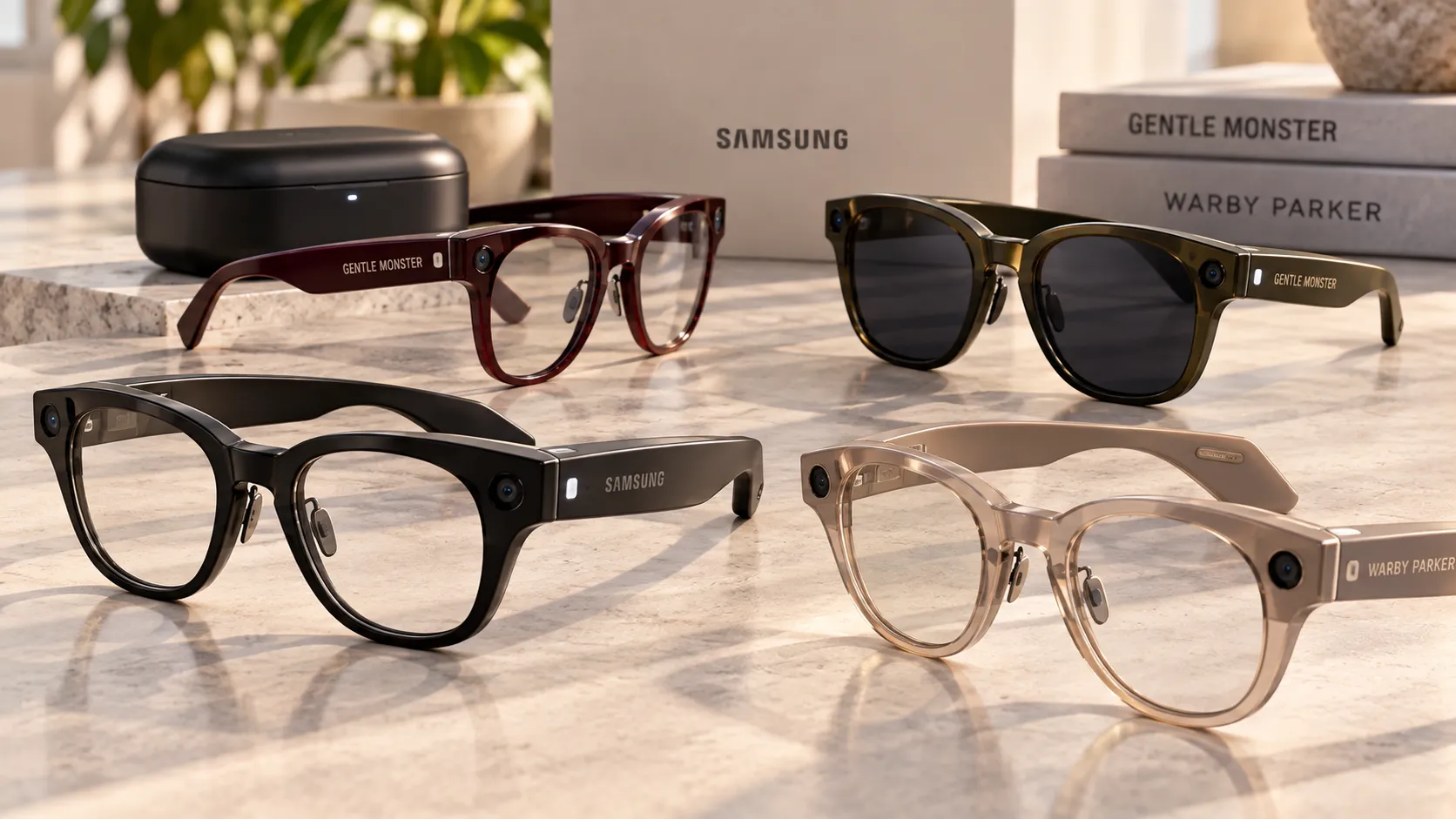
Samsung didn't design its own frames and hand them to fashion consultants for a cosmetic pass. It outsourced the design entirely to two established eyewear brands. Gentle Monster handled a fashion-forward slim black frame with a straight upper rim and softly rounded lower edges. Warby Parker produced a brown upswept style aimed at everyday settings. Both are confirmed in Samsung's global press release last week.
The logic extends the companion-device thesis into appearance. If these glasses are meant for all-day wear, they have to look like something people would choose to wear all day regardless of what's inside them. Camera glasses have consistently looked like tech products wearing a frame rather than eyewear that happened to contain technology. Partnering with brands that already have optical credibility is an attempt to close that gap rather than fight it.
Samsung worked with both partners to refine specific fit points, including forehead and ear contact, per the global press release. For a device claiming nine hours of continuous wear, those details aren't cosmetic. How the frame contacts the face determines whether someone keeps the glasses on past the first hour or pockets them and reaches for their phone instead, which would defeat the purpose entirely.
The two design registers are also strategically distinct. Gentle Monster, known for editorial fashion aesthetics, targets style-conscious buyers. Warby Parker, whose mainstream credibility comes from making glasses feel accessible and normal, targets everyone else. Together they cover the range Samsung needs if everyday eyewear is actually going to mean everyday. The "everyday eyewear" framing in Samsung's press materials isn't marketing gloss it's the organizing principle behind these partnerships, the audio-first hardware, and the display-free design. Each decision applies the same underlying logic: make the product feel like something people already understand and want, then add the technology on top.
The honest caveat is that none of this has been tested outside Samsung and its partners. Whether the execution delivers on comfort and wearability is a question the fall launch in select markets will answer.
The camera on the frame: why the privacy problem doesn't dissolve for Samsung smart glasses
Everything described above reflects choices Samsung made to support a modest, everyday-wear thesis. The built-in camera is the one feature that cuts against it, and it isn't optional. The camera is what makes Gemini contextually useful: reading menus, capturing whiteboards, sharing first-person views during calls, translating text on signs. Remove it and the core value proposition collapses. But a camera on someone's face in a social setting is a social act, and the research on how people respond to that is not encouraging.
A 2024 study published at ACM CHI found that wearers of camera glasses felt personally responsible for protecting bystanders' privacy a burden the technology gave them no reliable tools to fulfill. LED recording indicators, the standard signaling mechanism, were found to be unreliable in practice: difficult to see in bright outdoor conditions, and not necessarily understood by others even when visible. One study participant noted the LED "would not be noticeable if you're at a lake, where the pond is glittering." Another observed that the light was weak enough that "if people are a little bit far away from you, then you can take pictures of anything that you want." Without a credible signaling mechanism, wearers risked continuous suspicion of recording in socially inappropriate moments a stigma independent of whether they were actually capturing anything.
The burden is asymmetric in a way that no product design choice resolves cleanly. The ACM CHI research found that bystanders' privacy ultimately depends on the outlook and attitude of whoever is wearing the device. Participants reported that the only recourse available to bystanders was to trust in the wearer's good intentions. That's not a mechanism. It's an absence of one. Some participants said they would simply avoid wearing the glasses in certain social settings to sidestep the problem a self-imposed restriction that narrows the product's everyday-wear claim considerably.
The cultural dimension makes this harder, not easier. A 2025 peer-reviewed study in Applied Sciences surveyed 1,300 respondents across the U.S. and South Korea and found that Korean respondents rated their privacy concerns about AR smart glasses meaningfully higher than American respondents a mean of 6.17 versus 5.58 on a seven-point scale (p<0.001). That gap reflects different legal and cultural frameworks. South Korea's Supreme Court has ruled that photographing someone in a public space can constitute an illegal camera offense, while U.S. law generally permits public recording unless highly invasive circumstances exist, per the Applied Sciences study. For Samsung, a Korean company launching in Asian markets, that finding is directly relevant.
Samsung's response to this entire problem is a single phrase: "clear controls and safeguards support responsible and secure use," from the global press release. No recording indicators described. No on-device versus cloud processing specified. No consent mechanisms explained. The U.S. press release is marginally more candid, noting that live visual sharing and recording features "may vary by app, service, market and applicable laws or consent requirements" which reads more as an acknowledgment that rules and norms are unsettled than as a solution to them.
This isn't a reason to dismiss the product or the strategy. It's a reason to be precise about what the strategy does and doesn't solve. Samsung has built more wearable, more practical smart glasses than much of what came before. The companion-device framing makes the hardware lighter, the battery longer, and the use cases legible. None of that changes the social weight a camera on someone's face carries in a coffee shop or a meeting room weight that fashion partnerships and audio-first design don't address, and that Samsung hasn't publicly explained how it plans to manage.
Where the strategy lands and what it leaves open
Samsung's restraint is coherent. The company built a product that takes its own diagnosis seriously: audio-first AI, display-free hardware, phone-dependent processing, fashion-brand frames. The goal, as Samsung put it at launch, is AI assistance "without requiring every interaction to begin with a screen," per the global press release. Won-Joon Choi, Samsung's Chief Operating Officer of the Mobile eXperience Business, framed it as bringing "more personalized AI assistance naturally into the moments that make up everyday life." The product choices back that framing up which is more than can be said for most smart glasses launches.
The ecosystem ceiling is fixed before a single unit ships. The glasses require a Galaxy AI phone for core Gemini functionality and a Watch9 for gesture controls, per the U.S. press release. That's a hard stop for anyone outside Samsung's installed base. It also means the fall launch is less a consumer product introduction than a cross-device upgrade pitch to people who already own Samsung hardware and it may work on exactly those terms.
The execution questions real-world comfort over a full day, Gemini's performance outside a demo environment, how the two frame designs hold up to actual daily use will start getting answered when the product reaches select markets this fall. What won't be answered by launch, unless Samsung says more before then, is the harder question. Research from ACM CHI and Applied Sciences indicates the privacy problem with camera glasses is structural: the technology places a burden on wearers that no current indicator or safeguard reliably discharges, and that burden is amplified in markets where recording norms are stricter than in the U.S. Samsung's modest framing lowers one adoption barrier. The camera raises another. Whether "clear safeguards" turns out to describe something concrete and whether Samsung explains that before or after people start wearing these in public may matter more to long-term adoption than any of the hardware choices the company got right.


Comments
Be the first, drop a comment!