





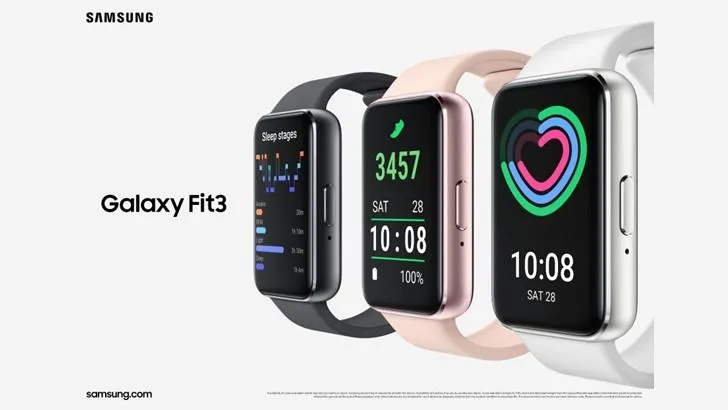
Samsung's next budget fitness tracker is coming into focus, and anyone expecting a dramatic redesign may be disappointed. Newly uncovered Galaxy Fit 4 renders show a device that looks remarkably similar to the Galaxy Fit 3, with Bluetooth 5.4 emerging as the clearest documented upgrade.
The images surfaced on October 22, 2026, giving the most detailed look yet at Samsung's unannounced wearable. They reveal three color options, a familiar rectangular display, and a physical button in almost the same position as its predecessor. Regulatory records also identify the device as model SM-R391, adding weight to reports that Samsung is preparing another entry in its affordable fitness lineup.
But the details that could make the Galaxy Fit 4 worth buying remain unresolved. Samsung has not announced its price, release date, battery endurance, or whether it will add standalone GPS. For existing Fit 3 owners, those missing specifications matter considerably more than a minor Bluetooth version change.
Galaxy Fit 4 renders reveal three colors and few design changes
The clearest images come from 360-degree Galaxy Fit 4 renders obtained by Notebookcheck through an APK teardown of a Samsung app. Unlike unofficial concept images, these assets were reportedly extracted from Samsung's software, although the company has not publicly confirmed them as final marketing materials.
The renders show a rounded rectangular display, slim frame, silicone strap, and single button along the right edge. It's a design that should feel immediately familiar to anyone who has used the Galaxy Fit 3. The overall shape appears nearly unchanged, suggesting Samsung is preserving the lightweight fitness-band format rather than moving toward a bulkier smartwatch design.
Three finishes appear in the images: black with a dark gray frame, white with a silver frame, and a pale blue or mint version with a silver frame. The default watch face also changes its accent colors to complement the straps.
The lighter option appears to replace the Fit 3's Pink Gold finish, although Samsung has not announced official color names. Reports describing the shade as green, mint, or light blue may be referring to the same finish.
There is also speculation that the Fit 4 could have a slightly larger display. The renders alone cannot establish its dimensions, however, and Samsung has not confirmed a screen size or resolution. The Galaxy Fit 3's 1.6-inch AMOLED panel remains the only reliable reference point.
The familiar appearance extends to the back. In an August 4 investigation, Android Authority examined Galaxy Fit 4 documentation identifying model SM-R391, with some records explicitly using the designation "FIT4." The accompanying rear render showed an optical sensor area, charging contacts, and strap attachment hardware resembling those on the previous model.
The Galaxy Fit 4 also received FCC certification in August 2026. That regulatory milestone provides stronger evidence of a product in development than leaked images alone, but it does not establish when Samsung will release the tracker or which countries will receive it.
Bluetooth 5.4 is confirmed, but bigger upgrades remain uncertain
Bluetooth 5.4 is the most concrete specification change identified in the Galaxy Fit 4's certification reporting. The Galaxy Fit 3 uses Bluetooth 5.3, making the newer standard a modest generational update.
The documentation lists Bluetooth Low Energy and Enhanced Data Rate support. Bluetooth Low Energy is particularly relevant to fitness trackers because it allows devices to exchange information with connected smartphones while limiting power consumption.
That doesn't mean the Fit 4 will automatically deliver better battery life, faster synchronization, or fewer connection interruptions. Those outcomes depend on the radio hardware, firmware, and how Samsung implements the standard.
A Bluetooth upgrade may be useful, but it is unlikely to be the deciding factor for someone who primarily uses a fitness band to check notifications, record workouts, or monitor sleep.
The health-tracking hardware presents another unanswered question. Earlier documentation points to a possible Goodix GH3036 optical sensor module intended for low-power biometric monitoring. That suggests Samsung may be making internal changes even if the exterior remains familiar.
However, identifying a possible sensor component is not the same as demonstrating improved tracking. Samsung has not confirmed whether the Fit 4 will measure heart rate, sleep patterns, or other health metrics more accurately than the Fit 3.
Independent testing will be especially important here. A newer sensor can offer different capabilities or efficiency characteristics, but software processing, sensor placement, and fit against the wrist also affect measurement quality.
The operating system is another area where Samsung appears likely to maintain its existing approach. The Galaxy Fit 3 uses a lightweight real-time operating system rather than Wear OS, allowing it to concentrate on basic fitness functions without the complexity of a full smartwatch platform.
The Fit 4 may follow the same approach, although its software has not been officially detailed. Buyers should not assume it will support the broader app selection available on Samsung's Galaxy Watch models.
Built-in GPS could make a bigger difference
One potential improvement would be far more noticeable than Bluetooth 5.4: standalone GPS.
The Galaxy Fit 3 relies on a paired smartphone for route tracking. That arrangement works when someone carries a phone during a run or bike ride, but it is less convenient for people who prefer exercising without one.
Built-in GPS would allow the Fit 4 to record outdoor routes independently, making it more useful for runners, cyclists, and walkers who want to leave their phones behind.
Neither the available certification reporting nor the leaked renders establish that Samsung has added the feature. Some reports have interpreted the absence of GPS information in regulatory documents as a sign that the Fit 4 will retain its predecessor's limitations. Until Samsung publishes final specifications, that remains an inference rather than a confirmed omission.
NFC is similarly uncertain. The Galaxy Fit 3 does not support contactless payments, and there is no verified indication that the Fit 4 will introduce them.
Battery endurance is equally important. Samsung rated the Fit 3 for up to 13 days under specified test conditions, although actual usage varies with display settings, notifications, and activity tracking. The Fit 4's battery capacity and expected endurance have not been announced.
A meaningful improvement in any of these areas would give buyers a clearer reason to choose the newer model.
Galaxy Fit 4 vs. Fit 3: Should you wait to upgrade?
The Galaxy Fit 3 already covers many of the functions people expect from an affordable fitness tracker. It has an AMOLED display, heart-rate monitoring, sleep tracking, more than 100 supported workout types, and customizable watch faces.
It also handles smartphone notifications and basic controls without requiring the larger display or more extensive software of a Galaxy Watch. For someone interested mainly in daily activity tracking, those features may be sufficient.
Samsung introduced the Fit 3 internationally in February 2024 before bringing it to the United States on January 9, 2025, at a starting price of $59.99. That affordable positioning is an important part of the product's appeal, especially for buyers who do not need a full smartwatch.
The Fit 4's price remains unknown, so it is too early to assume Samsung will maintain the same figure. If the company introduces meaningful hardware improvements without substantially raising the price, the newer tracker could become an attractive replacement.
Competition has also changed since the Fit 3's original release. Google announced the Fitbit Edge at $179.99 in October 2026, offering built-in GPS and more advanced health and coaching features. It occupies a considerably higher price bracket, but illustrates the additional capabilities available in more expensive fitness trackers.
The comparison also highlights the importance of Samsung's eventual pricing. A Galaxy Fit 4 near $60 would appeal to a different buyer than a $180 fitness band, particularly someone who values straightforward activity tracking over advanced coaching or phone-free route recording.
There are practical reasons to wait for Samsung's announcement before purchasing either Galaxy Fit model. The Fit 4 could bring improved sensors, better endurance, or software refinements that are not apparent in the leaked renders. It could also arrive with relatively few functional changes.
For existing Fit 3 owners, the decision is simpler. Bluetooth 5.4 and a familiar design do not yet offer a compelling reason to replace a tracker that still works well. A confirmed improvement in GPS capability, tracking accuracy, or battery life would make that decision more interesting.
First-time buyers face a different calculation. If the Fit 3 is available at a substantial discount, it may remain a sensible choice for basic fitness tracking. If prices are close, waiting for the Fit 4's complete specifications and independent reviews could help avoid buying an older model just before a potentially useful update.
The leaked images make one thing clear: Samsung is not reinventing the Galaxy Fit's appearance. Whether it is improving the experience underneath that familiar design is still an open question.
Until Samsung reveals the final hardware and pricing, the Galaxy Fit 4 is a product worth watching rather than an upgrade worth planning. The most important changes, if there are any, will be the ones users notice during a workout, not the ones printed on a specification sheet.


Comments
Be the first, drop a comment!