





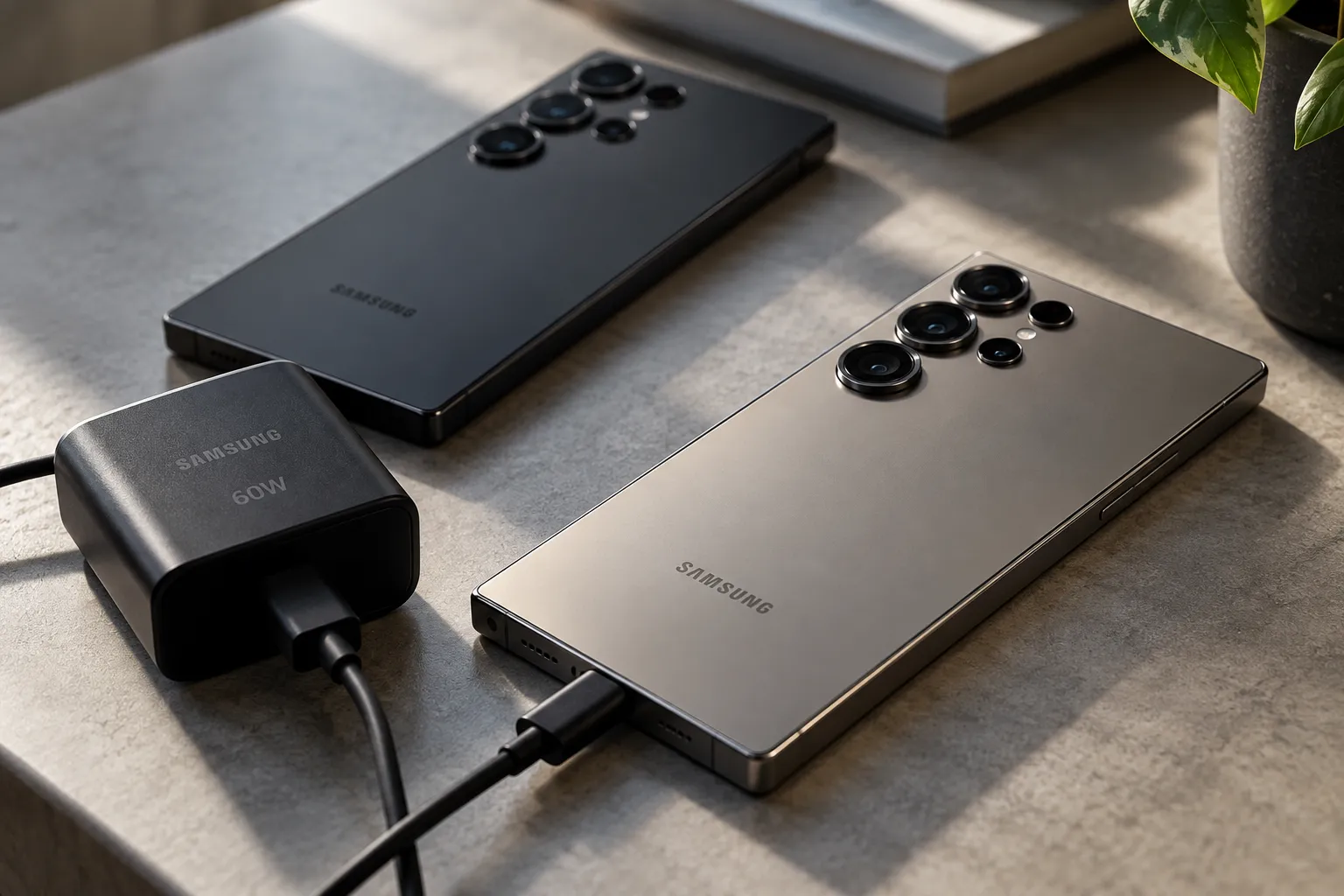
A leaker claims Samsung has reworked how the Galaxy S27 Ultra manages power during charging, potentially improving charging speed by 2% to 3% over the Galaxy S26 Ultra.
The phone is also rumored to pack a notably larger battery, raising a practical question: could it charge faster despite having more capacity to fill, or would the optimization simply offset the additional charging time?
The charging claim comes from tipster WalleGalaxy, who says Samsung's changes would let the Galaxy S27 Ultra sustain higher wattage for longer. SamMobile and Android Headlines have reported the leak, but neither has independently verified the claimed improvement.
Every S27 Ultra-specific charging figure, including the 60W ceiling, the 55W to 56W sustained output, the reported 58W peak, and the 2% to 3% gain, remains unconfirmed. Battery capacity estimates have also varied, with earlier reports suggesting 5,700mAh and newer leaks pointing to a possible 5,800mAh typical capacity. Samsung hasn't confirmed the battery, charging behavior, or optimization. The Galaxy S27 lineup is expected to launch in early 2027.
What the Galaxy S27 Ultra charging curve rumor claims
This isn't a rumor about Galaxy S27 Ultra fast charging exceeding 60W. WalleGalaxy's claim is narrower: the phone would maintain roughly 55W to 56W for a longer stretch of the charging cycle than the S26 Ultra, rather than raising the maximum wattage.
During alleged internal testing, the phone reportedly reached a peak of 58W, slightly below the expected 60W rating. The claimed improvement comes from sustaining relatively high power for longer during the initial charging phase.
That distinction matters because a phone's maximum charging wattage doesn't represent the power it delivers throughout a full charge. Charging generally slows as the battery fills, so the amount of time spent at higher wattages can influence overall charging performance.
The Galaxy S26 Ultra increased Samsung's maximum wired charging rating from the Galaxy S25 Ultra's 45W to 60W. However, the difference between maximum rated wattage and sustained charging power means the higher figure doesn't automatically translate into a proportional reduction in charging time.
Neither Android Headlines nor the other reports establishes the Galaxy S27 Ultra's actual charging curve through independent testing. The proposed improvement remains a leak rather than a measured performance result.
Galaxy S27 Ultra vs S26 Ultra charging speed: bigger battery, same wattage
The Galaxy S27 Ultra is rumored to feature a larger battery while retaining the S26 Ultra's 60W wired charging limit. More capacity at an unchanged maximum wattage is the central question behind this rumor. A larger battery generally requires more energy to reach full charge, so any claimed speed improvement needs to account for that difference.
The Galaxy S26 Ultra provides a confirmed reference point. According to Samsung's official specifications, it has a 5,000mAh typical battery capacity and supports 60W Super Fast Charging 3.0.
Samsung says the S26 Ultra can reach approximately 75% charge in 30 minutes under its specified test conditions. That is an official partial-charge claim, not a published full-charge time.
Earlier Galaxy S27 Ultra reports suggested a 5,700mAh battery, which would represent a 14% increase over the S26 Ultra's capacity.
More recent SamMobile reporting describes battery certification records for the S27 Ultra and a separate leak suggesting a 5,534mAh rated capacity, potentially marketed as 5,800mAh typical capacity. The certification images don't independently establish that capacity.
If the 5,800mAh figure proves accurate, it would represent a 16% increase over the S26 Ultra's 5,000mAh battery. Neither estimate has been officially confirmed by Samsung.
The reported 2% to 3% improvement also needs careful interpretation. SamMobile frames the claim as the Galaxy S27 Ultra reaching a full charge approximately 2% to 3% sooner than the S26 Ultra, rather than merely increasing peak charging power by that percentage.
If the S26 Ultra takes approximately 45 minutes to charge fully under a particular test setup, a 2% to 3% reduction would amount to roughly 54 to 81 seconds saved.
That's a mathematical illustration, not a verified charging-time comparison. The leaker hasn't disclosed the charger, cable, ambient temperature, battery temperature, or other test conditions needed to establish whether the improvement is reproducible.
Phones reduce charging power as their batteries approach full capacity to manage temperature, voltage, and battery health. Sustaining higher wattage for longer during the earlier stages of charging can therefore reduce total charging time without changing the maximum rating.
That's the principle behind WalleGalaxy's claim, but it doesn't establish that Samsung has achieved the reported improvement on the S27 Ultra.
What to check before Samsung's Galaxy S27 Ultra launch
The confirmed-versus-rumored distinction is straightforward. The Galaxy S26 Ultra's 60W wired charging limit and 5,000mAh battery are official specifications. Every S27 Ultra-specific charging figure, including the reported 58W peak, 55W to 56W sustained output, and 2% to 3% improvement, remains unverified.
The larger battery is also unconfirmed. Recent certification reporting supports the existence of battery components associated with the upcoming model, but it doesn't establish the final marketed capacity.
For buyers considering the rest of the lineup, this particular charging optimization rumor concerns the Ultra model. Samsung is also expected to introduce the Galaxy S27, Galaxy S27+, and Galaxy S27 Pro, but there's no confirmation that they will use the same charging approach.
Separate certification reports suggest the standard Galaxy S27 and S27+ may retain 25W and 45W wired charging, respectively. Those findings don't establish whether the models will receive other charging-management improvements.
Current Galaxy S26 Ultra owners also shouldn't count on the rumored optimization arriving through a software update. SamMobile says it's unknown whether Samsung could bring the changes to older models through firmware, so there's no confirmed update path for existing hardware.
Once independent reviews become available, the useful comparison will be charging times measured under matched conditions, not simply the maximum wattage listed on a specification sheet.
Reviewers should measure how long each device takes to reach 50%, 80%, and 100% from the same starting charge level. They should also compare power delivery during the early charging phase and use equivalent chargers, cables, ambient temperatures, and battery conditions.
Those tests would help establish whether the Galaxy S27 Ultra actually charges faster despite its potentially larger battery, and whether the improvement is noticeable in everyday use.
Because the claim rests on unverified testing without published methodology, it isn't enough to justify an upgrade decision.
For now, S26 Ultra owners have no confirmed firmware path to the optimization, and the reported speed improvement remains too small and uncertain to act on. Wait for Samsung's official Galaxy S27 Ultra specifications at the expected early-2027 unveiling, then compare independent charging tests against the S26 Ultra before assuming the optimization delivers a meaningful advantage.






Comments
Be the first, drop a comment!