



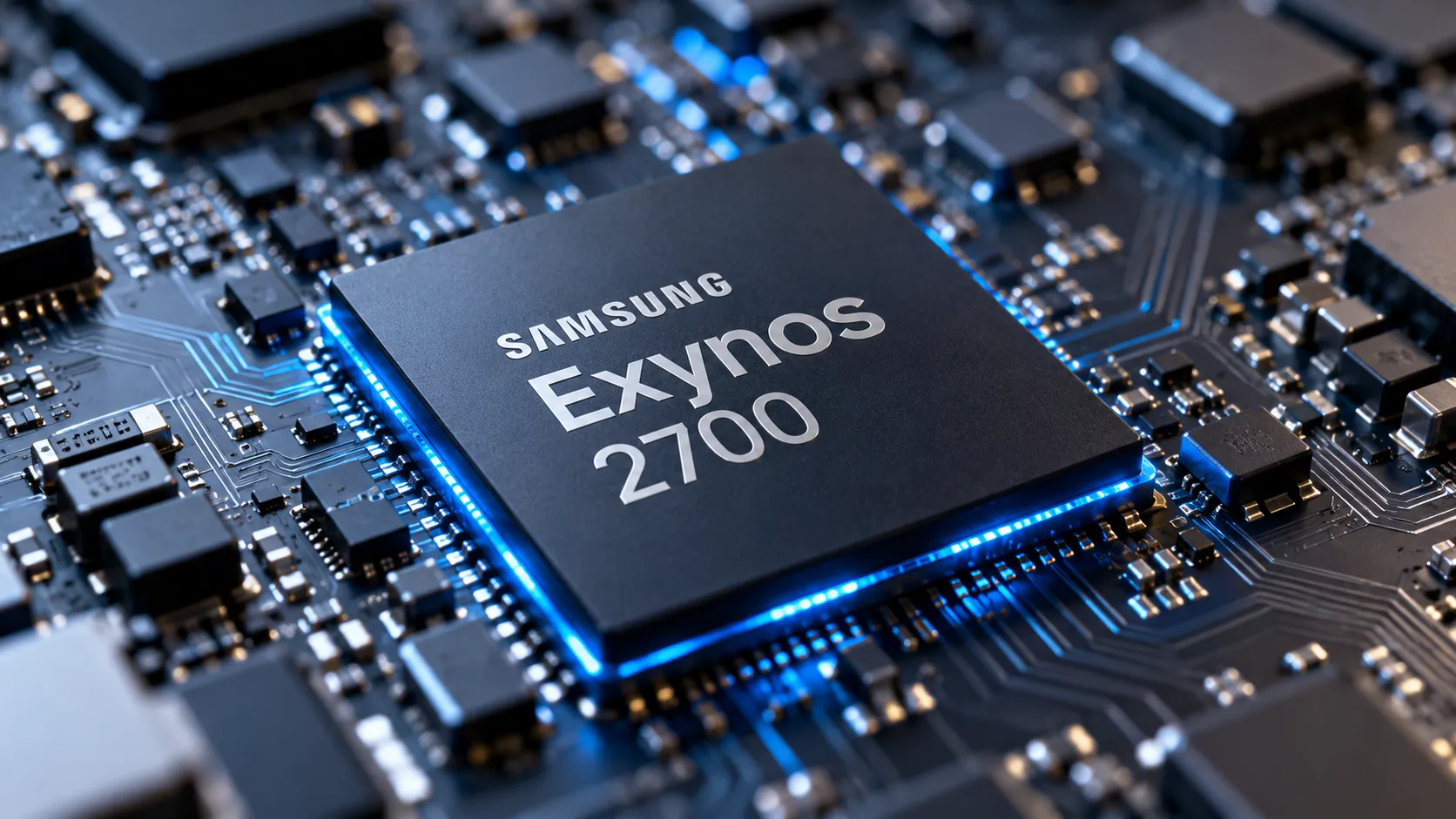
The Exynos 2700 story has moved from early chip leaks to reported factory production. Samsung has started front-end mass production of the processor expected to power at least part of its 2027 Galaxy S27 lineup, according to industry sources.
Wafers typically take three to four months to move from front-end fabrication through testing and packaging into finished chips. That makes the start of wafer production a stronger signal than an early benchmark leak, although Samsung still hasn't officially announced the Exynos 2700, Galaxy S27 lineup, or regional processor plan.
The latest report from The Elec says Samsung's mobile division has now determined Exynos 2700 volumes for the Galaxy S27, S27 Plus, and reported new S27 Pro before front-end wafer production began. The same report says Samsung still hasn't decided whether the Galaxy S27 Ultra will use Exynos at all.
The reported regional plan has also narrowed since an earlier July leak. The newest sourcing specifically names the S27, S27 Plus, and S27 Pro in South Korea and Europe for Exynos 2700, while the US, China, and other markets are expected to use Qualcomm's Snapdragon 8 Elite Gen 6 series.
What Exynos 2700 mass production actually tells us
Samsung reportedly moved beyond small-volume sampling and started running Exynos 2700 wafers through its front-end foundry production line in early October.
An industry source cited by The Elec said Samsung MX had not finalized Exynos allocation ratios as recently as September but has now determined the volume required for the Galaxy S27, S27 Plus, and S27 Pro.
That is a more substantial production commitment than engineering samples, but it still isn't the same as Samsung publicly confirming which retail phones will contain the processor.
Production volume is reportedly more than 10% higher than it was for the Exynos 2600. The Elec attributes the increase primarily to the addition of the new Pro model, which adds another potential Exynos-equipped Galaxy S27 variant.
SamMobile independently summarized the same Korean reporting, saying Samsung is producing more Exynos 2700 chips than the previous generation while the Galaxy S27 Ultra allocation remains unresolved.
Samsung itself has not announced the Galaxy S27 Pro name. Until the company unveils the lineup, both the model and its Exynos allocation remain reported plans rather than official product specifications.
Galaxy S27 Pro chipset by region remains incomplete
The newest production-stage report is more specific than the July leak, but it still doesn't give buyers a complete global map.
The Elec says the Galaxy S27, S27 Plus, and S27 Pro will use the Exynos 2700 in South Korea and Europe.
For the US, China, and other regions, the publication says Samsung is expected to use Qualcomm's Snapdragon 8 Elite Gen 6 series.
Qualcomm officially announced two flagship processors in September: the Snapdragon 8 Elite Gen 6 and the higher-end Snapdragon 8 Elite Extreme Gen 6. The standard Gen 6 is the relevant reported alternative for the regular S27 models, while the Extreme chip is the leading Snapdragon candidate for the Ultra.
That regional picture doesn't fully match the broader leak from July.
The earlier report, originally attributed to Money Today, said Exynos 2700 could reach the Galaxy S27 Pro in most markets outside North America, including Asia, Australia, Europe, Africa, and Latin America. TechRepublic covered the same reported split, with Snapdragon reserved for Canada, Mexico, and the US.
The newer Elec report specifically names Korea and Europe for Exynos and the US and China among the Snapdragon markets. It doesn't spell out what happens in India, Japan, Canada, Australia, Latin America, Africa, or every other region.
That makes the July map too broad to treat as current fact. Buyers outside the markets explicitly named in the newest report still don't have a reliable chipset allocation.
Galaxy S27 Ultra: Exynos 2700 still undecided
Samsung reportedly hasn't decided whether the Galaxy S27 Ultra will use the Exynos 2700 or how many Ultra units would receive it if the chip is selected.
The Elec describes disagreement between Samsung's semiconductor and mobile divisions.
Samsung System LSI, which designs Exynos processors, reportedly wants the Exynos 2700 inside the Ultra. Samsung MX, which controls the final smartphone decision, is said to be weighing performance, thermal behavior, manufacturing capacity, and cost before committing.
The Galaxy S26 Ultra used Qualcomm's flagship Snapdragon platform globally. An Exynos-equipped S27 Ultra would therefore mark a significant shift back toward Samsung's own silicon at the top of the lineup.
Earlier reporting leaned more heavily toward another Snapdragon-only Ultra. SamMobile said in July that the S27 Ultra could remain the only model in the lineup using Snapdragon globally, while TechRepublic used similar conditional language.
The October report supersedes any suggestion that outcome is already settled. Samsung MX is still deciding.
Galaxy S27 Pro Snapdragon vs Exynos: what the benchmark claims show
The early benchmark story also needs careful attribution.
The Elec reports that a claim has circulated about Samsung internal Geekbench 6 testing in which the Exynos 2700 scored 9.5% higher in multi-core performance than Qualcomm's Snapdragon 8 Elite Extreme Gen 6.
Qualcomm's Extreme chip reportedly scored 12,856 in multi-core and 4,308 in single-core Geekbench 6 testing. A 9.5% advantage over 12,856 would put the reported Exynos multi-core result at roughly 14,077.
The Exynos chip is still expected to trail Qualcomm in single-core performance.
Those aren't independent retail benchmarks. The Exynos 2700 isn't a shipping processor, the test hardware and conditions haven't been published, and Samsung has not released an official benchmark result.
The comparison is also most relevant to the unresolved Galaxy S27 Ultra decision.
Qualcomm positions the Snapdragon 8 Elite Extreme Gen 6 as its highest-end mobile platform. The regular Snapdragon 8 Elite Gen 6 is the chip family member more directly relevant to the base, Plus, and Pro regional split described in The Elec's report.
So the reported 9.5% multi-core advantage should not be read as a benchmark comparison between the two processors most S27 Pro buyers would necessarily choose between.
What SF2P could change
The Exynos 2700 is reportedly being manufactured on Samsung Foundry's second-generation 2nm process, known as SF2P.
The Elec reports that SF2P can deliver 12% higher performance, 25% lower power consumption, and an 8% reduction in chip area compared with the first-generation SF2 process used for the Exynos 2600.
Those are process-level figures, not measured Exynos 2700 gains.
Samsung's own public disclosures confirm that it is ramping production of second-generation 2nm products in 2026. The company said in its second-quarter results that it planned to increase production of new mobile products based on its second-generation 2nm process during the second half of the year.
Samsung's current public Foundry material does not provide an Exynos 2700 specification sheet tying the 12%, 25%, and 8% figures directly to finished phone performance.
Even if those process improvements hold, they don't translate directly into a phone that's 12% faster or uses 25% less battery. Chip architecture, clocks, modem behavior, cooling, display power, software, and workload all affect what reaches the user.
Independent testing will still be needed for sustained performance, thermals, battery life, modem efficiency, gaming, and camera processing.
What the latest report changes
The start of Exynos 2700 wafer production is the strongest new signal yet that Samsung intends to use the chip at meaningful volume in the Galaxy S27 generation.
The Elec reports that production is more than 10% higher than the previous Exynos generation and ties that increase to the addition of the Galaxy S27 Pro. It also says Samsung has determined Exynos volumes for the base, Plus, and Pro models.
The regional picture is less complete.
The newest sourcing points to Exynos 2700 in South Korea and Europe and Snapdragon 8 Elite Gen 6-series chips in the US, China, and other markets. That is narrower than the July claim that Exynos would cover almost every market outside North America.
The Galaxy S27 Ultra remains unresolved, with Samsung MX reportedly still deciding between Exynos 2700 and Qualcomm's higher-end Snapdragon 8 Elite Extreme Gen 6.
And none of Samsung's Galaxy S27 plans are official yet.
For buyers, the practical checkpoints haven't changed: wait for Samsung's regional product pages to confirm which processor ships in each market, then wait for independent testing before using early Geekbench scores or foundry-level efficiency figures to judge one version against another.









Comments
Be the first, drop a comment!