Header Banner
Gadget Hacks Logo
Gadget Hacks
Samsung
gadgethacks.mark.png
Gadget Hacks Shop Apple Guides Android Guides iPhone Guides Mac Guides Pixel Guides Samsung Guides Tweaks & Hacks Privacy & Security Productivity Hacks Movies & TV Smartphone Gaming Music & Audio Travel Tips Videography Tips Chat Apps
Home
Samsung

Exynos 2700 vs Snapdragon 8 Elite Gen 6: Claims Explained

Exynos 2700 vs Snapdragon 8 Elite Gen 6: Claims Explained

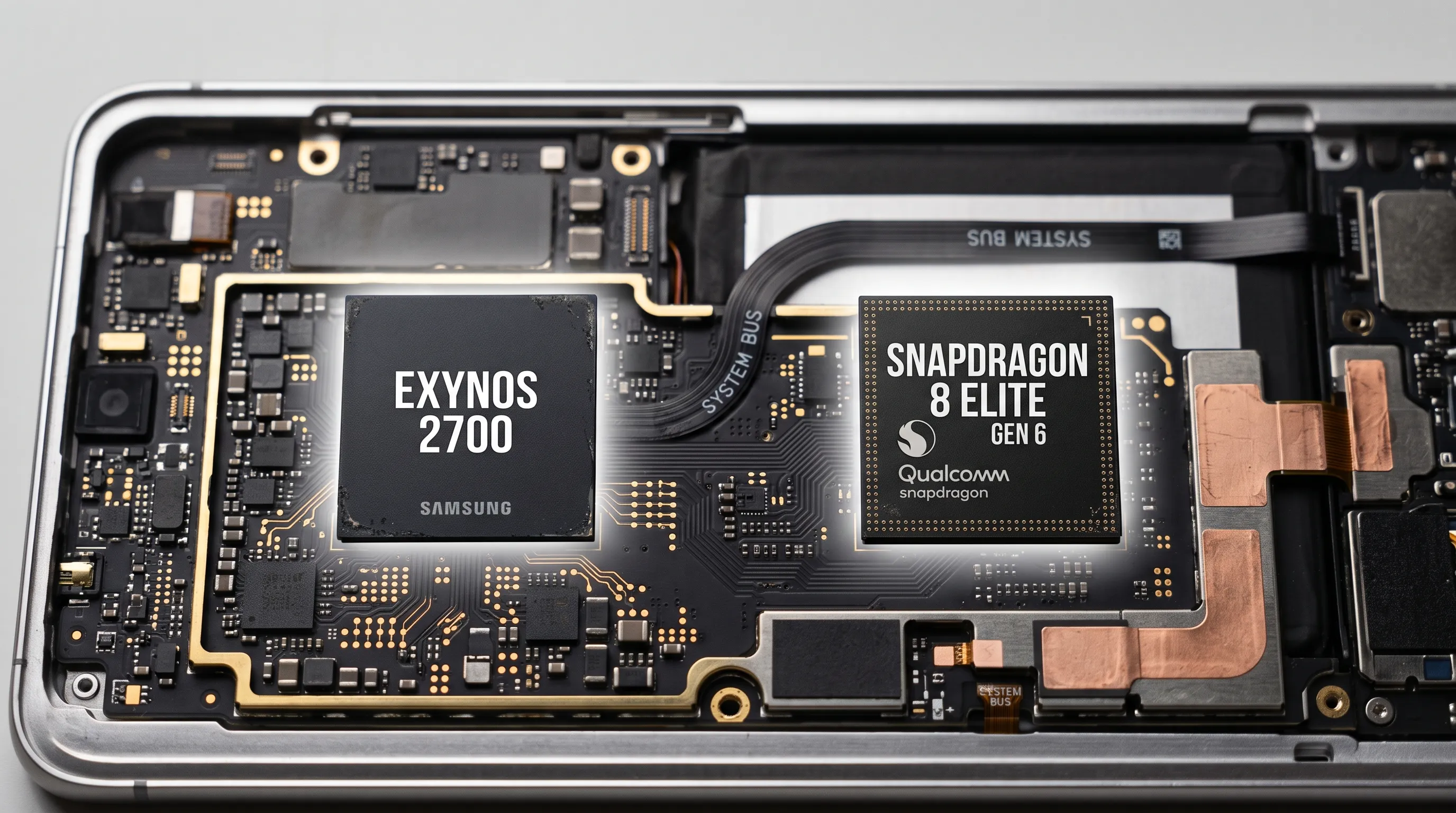
A Korean business outlet reported this week that Samsung's unreleased Exynos 2700 beat Qualcomm's upcoming Snapdragon 8 Elite Gen 6 across CPU, GPU, AI, and power efficiency, citing industry sources familiar with Samsung's own internal testing. If the numbers hold up, the Exynos 2700 vs Snapdragon 8 Elite Gen 6 matchup described in the report would mark a major reversal in Samsung's flagship-chip strategy: an unproven Samsung part outscoring an upcoming Qualcomm chip and its reported higher-end "Pro" variant on nearly every metric that matters (Seoul Economic Daily, this week).

Samsung's MX division reportedly ran the comparison itself, testing the Exynos 2700 against both the standard Snapdragon 8 Elite Gen 6 and a reported Pro variant (Seoul Economic Daily, this week). Samsung has confirmed the chip is in development and aimed at "top-tier" smartphones, but a company official declined to verify the specific figures now circulating (Android Authority, two months ago; Seoul Economic Daily, this week).

What follows walks through the actual numbers, the gaps in how they were produced, the engineering rationale behind them, the financial pressure driving Samsung's push, and the delivery record that should temper expectations before the Galaxy S27 arrives, expected in early 2027 (GSMArena, three months ago).

Exynos 2700 vs Snapdragon 8 Elite Gen 6: reported benchmark results

Start with the CPU. On Geekbench 6.5's multicore test, a measure of sustained multi-threaded processing rather than overall phone speed, the Exynos 2700 reportedly scored 19% higher than the standard Snapdragon 8 Elite Gen 6 and 9.5% higher than the Pro variant (Seoul Economic Daily, this week). That's a wide enough margin that, if it survives contact with retail hardware, would be a notable break from a run of Exynos generations that struggled to keep pace with Qualcomm.

The GPU figures are more specific, and more interesting. At a reported 2.5-watt power limit, described in the report as a low-power environment, the Exynos 2700 delivered 24% higher performance than the standard Qualcomm chip and 22% higher than the Pro model. At uncapped peak power, its edge over the Pro chip narrowed to 5% (Seoul Economic Daily, this week). A low-power result may be more relevant to sustained phone use than a peak score, though the report doesn't disclose the test conditions closely enough to say how directly it maps onto real-world battery life.

On AI, Samsung reportedly ran an on-device test using the Llama 3.1 8B model. The Exynos 2700 generated responses 18% faster than Qualcomm's Pro chip and processed incoming prompts 5% faster, while a simulated real-use power measurement showed it drawing 161 milliamperes against 185 mA for the Qualcomm part, a 12.7% reduction (Seoul Economic Daily, this week). Milliamperes alone measure current draw, not total energy; without matching voltage and test duration, that figure describes relative draw in one specific test rather than a complete power comparison.

These are reported internal results, not independently established ones. They trace to a single story, sourced to unnamed industry contacts, describing tests that Samsung's own MX division ran on its own hardware against a rival chip that, for the Pro variant, hasn't been detailed by Qualcomm at all. None of that makes the figures false. It makes them a company's characterization of its own product, tested on its own terms.

What the numbers don't tell you

A benchmark score is difficult to interpret without the conditions that produced it, and the report doesn't specify most of them.

The supplied reporting doesn't say what test devices were used: reference boards, engineering samples, or something closer to production hardware. It doesn't mention the cooling setup, which matters for a sustained GPU test, since a well-cooled test rig can make a chip look better than it would inside a phone's frame after ten minutes of gaming. Clock speeds, memory configuration, and software builds aren't disclosed either.

There's also an open question about repetition. Readers would normally want to know whether Samsung averaged multiple test runs and reported variance, or whether these figures reflect a single pass. The report doesn't say. And it's unclear whether the Qualcomm "Pro" chip used in the comparison was final retail silicon or early sample hardware, a distinction that would matter for judging how comparable the two setups actually were.

None of this means the reported figures are wrong. It means the article's central claim, that Samsung's chip wins across the board, isn't something anyone outside Samsung can currently check. That distinction, between a promising internal result and a confirmed win, is really the whole story around Exynos 2700 power efficiency and performance until independent testing arrives.

The engineering behind the performance claims

The report offers no test setup, but other reporting points to design changes that could plausibly affect sustained performance.

The chip is expected to be built on SF2P, Samsung Foundry's second-generation 2-nanometer process, expected to deliver improved yields and performance over the first-generation node used in the Exynos 2600 (Korea Herald, earlier this year). A newer node alone wouldn't explain a 20-plus percent lead over a rival flagship, but it's the foundation the rest of the design sits on.

More telling is the packaging change. Multiple reports describe Samsung moving from stacked DRAM to a side-by-side layout, where the processor and memory sit next to each other on the same substrate (Android Authority, four months ago; GSMArena, three months ago). Samsung's Heat Path Block, essentially a heat sink, would then cover both components instead of just the processor, as it does on the Exynos 2600 (Android Authority, two months ago). Keeping DRAM cool alongside the processor could reduce thermal throttling under sustained load, which lines up with why the reported GPU advantage is largest at a constrained power level rather than at peak.

Independent hardware evidence is thin but not absent. A 10-core engineering-board sample carrying the model number S5E9975 surfaced on Geekbench with an Xclipse 970 GPU, scoring 2,603 single-core and 10,350 multi-core (GSMArena, four months ago). Those scores predate the internal benchmark claims and came from early engineering hardware, so they can't be compared directly to the August figures. What the listing indicates is that a working sample existed and was being tested months before Samsung's reported internal comparison took place, which lends some real-world grounding to the Samsung Exynos 2700 performance story beyond a single leaked spreadsheet.

Why Samsung needs the Exynos 2700 to win

The engineering explains how Samsung might close the gap. The business pressure explains why it's under so much pressure to.

Samsung executive Park Yong-in said at a briefing that Exynos 2700 development is proceeding "without setbacks" toward top-tier smartphone use (Android Authority, two months ago). Kiwoom Securities analyst Park Yu-ak estimates the chip could power roughly 50% of Galaxy S27 units, up from an estimated 25% share for Exynos in the Galaxy S26 lineup (Korea Herald, earlier this year). That figure is a sourcing forecast, worth separating from the benchmark claims above; it says something about how much Samsung wants to rely on its own silicon, not about how that silicon actually performs.

The money behind the push is substantial. Industry data cited by Korea Herald put Samsung's spending on external mobile processors at roughly 11 trillion won, about $7.5 billion, through the first three quarters of last year. On top of that, the company reportedly paid around $400 million to secure Qualcomm chips for the Galaxy S25 lineup after its own chip development fell behind schedule (Korea Herald, earlier this year). Those purchases illustrate the cost of relying on an outside supplier, a cost Samsung's chip design and foundry divisions have felt directly, since both units, according to the same report, have posted combined losses since early 2023. Park Yu-ak's analysis suggests that if Exynos 2700 production ramps as planned, those divisions could return to operating profit by the end of this year (Korea Herald, earlier this year).

Moon Sung-hoon, vice president of hardware at Samsung's MX division, has said the company's eventual goal is powering every Galaxy device with Exynos chips, though he described that as a "mid- to long-term" roadmap rather than an imminent shift (Korea Herald, earlier this year). Samsung has expressed confidence in the Exynos 2700's development timeline while declining to confirm the specific benchmark figures now circulating, which leaves readers unable to distinguish a genuinely favorable internal result from a selective or preliminary comparison.

What Samsung's track record says about these claims

History is the least forgiving part of this story. The Exynos 2300 never reached mass production because of underperformance, and delays with the Exynos 2500 forced Samsung to equip its entire 2025 Galaxy S25 and Z Fold 7 lineups exclusively with Qualcomm chips (Korea Herald, earlier this year). Samsung's recent Exynos roadmap has already suffered two notable setbacks in a row.

The Exynos 2700's design was reportedly finalized in late 2025 and has since entered sample production, letting engineers validate performance and manufacturing stability ahead of full-scale output (Korea Herald, earlier this year). Industry sources in that same report targeted production-ready samples for the May-to-June window; that window has now passed. The chip remains unreleased, and the supplied reporting doesn't establish whether Samsung has reached final retail silicon or full-volume production. Chip validation timelines slip routinely, so that gap isn't necessarily a red flag on its own, but it's a gap worth naming.

Samsung's public position has been consistent: development is proceeding without setbacks, but the company has declined to confirm the specific figures behind this week's report (Android Authority, two months ago; Seoul Economic Daily, this week).

The real test is still ahead

Samsung's reported internal figures describe promising results, not a confirmed defeat of Qualcomm's next flagship. The reporting reviewed here contains no independent verification of the CPU, GPU, or AI numbers, and Samsung itself has declined to confirm them (Seoul Economic Daily, this week).

That gap won't stay open indefinitely. Production-ready samples were targeted for the middle of this year, and the Galaxy S27 is expected to launch in early 2027, which could provide an opportunity for independent testing before then (GSMArena, three months ago; Korea Herald, earlier this year). The evidence worth watching for is specific: retail-device Geekbench results, sustained GPU testing under real thermal conditions rather than a lab-controlled 2.5-watt cap, AI throughput measured against a clearly defined workload, and system-level power measurements across multiple Galaxy models and regions, not just one device in one market.

The more consequential question isn't whether Exynos 2700 beats Snapdragon 8 Elite Gen 6 by a few benchmark points in a Samsung-run test. It's whether Samsung Foundry can build the chip reliably, at the volume and consistency the Galaxy S27 lineup requires, after recent setbacks involving Exynos production and scheduling. That's the test no internal benchmark can settle in advance.

Apple's iOS 26 and iPadOS 26 updates are packed with new features, and you can try them before almost everyone else. First, check our list of supported iPhone and iPad models, then follow our step-by-step guide to install the iOS/iPadOS 26 beta — no paid developer account required.

Sponsored

Related Articles

Comments

No Comments Exist

Be the first, drop a comment!