



At MWC 2026 in Barcelona, Samsung Display was on the show floor with a phone that slides upward to reveal more screen. Back home, Samsung's product division was shipping a phone that unfolds twice. Both devices exist. Only one is for sale. That gap between what Samsung's display engineers can demonstrate and what its product team will actually commit to defines the current state of the Samsung rollable phone.
The MWC concept, reportedly called the "Mobile Slidable," expands from 5.1 inches to 6.7 inches as the rails slide upward, shifting the aspect ratio from 16:9 to a tall 22:9. No hinge, no crease, no foldable thickness penalty. In practice, one device could behave like a compact phone when closed and a taller one when extended.
For the LG prototype that Ars Technica examined earlier this year, a comparable rollable mechanism increased viewable area by about 40 percent without the added bulk of a foldable design. That is why Samsung, LG, Motorola, and Oppo have all circled this concept over the past several years.
None has shipped one. Samsung's slidable was labeled "under development" at MWC, and a 2022 Samsung prototype that expanded from both top and bottom simultaneously never made it to market. The concepts accumulate. The products don't follow. Understanding why requires looking at where Samsung is actually placing its bets, what the patent trail suggests about parallel design experiments, and what a teardown of a rival's failed attempt reveals about the engineering wall that no manufacturer has cleared.
Samsung's commercial priorities: foldables in, rollables out
Start with the money. Samsung's MX business outlined its H2 2025 smartphone strategy in its Q2 2025 financial results, describing a flagship-first approach centered on foldables and the Galaxy S25 series, with new form-factor expansion specifically identified as XR and TriFold devices. Rollables were not mentioned.
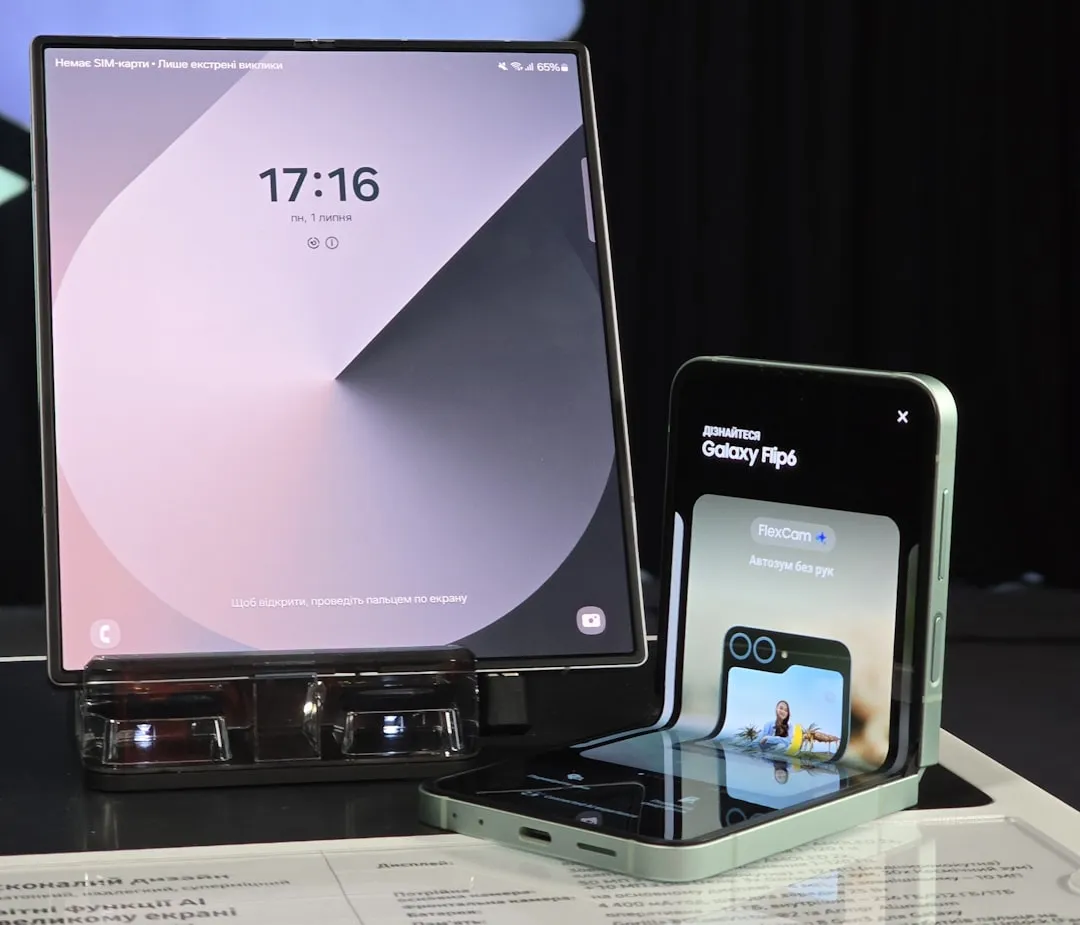
The Galaxy Z TriFold is where that "more screen" ambition has landed as an actual product. Announced in December 2025, the Galaxy Z TriFold became available first in Korea, followed by selected markets including the U.S. It opens to a 10-inch main display and folds down to a 6.5-inch cover screen. Samsung CEO TM Roh described it as solving "one of the mobile industry's longest-standing challenges," specifically the tradeoff between portability and screen size. That pitch overlaps heavily with the case a rollable would need to make.
The structural point is worth spelling out. Samsung Display can demo panel and mechanism experiments on a trade-show floor without those concepts ever surviving the gauntlet inside Samsung's product division: pricing review, reliability testing, carrier certification, repairability, and production yield targets. A concept that wows in Barcelona can fail any one of those tests. Right now, Samsung MX is commercializing flexible-screen hardware through hinges. Rollables are running on a separate R&D track that has not crossed into the product roadmap, and those two tracks are on visibly different timelines.
What the Samsung rollable phone patent trail actually shows
Samsung is not iterating on a single rollable design. It appears to be testing several distinct geometries, which is itself a signal that no approach has clearly resolved the underlying tradeoffs.
The MWC 2026 slidable extends vertically from the top, with a confirmed resolution of 1,080 x 2,640 FHD+ at 426 ppi when fully extended; rotating it produces a wide horizontal display suited to video or productivity.
A separate Samsung rollable phone patent surfaced about a year ago showing something very different: a compact, Galaxy Z Flip-style device that unrolls upward from a thick chin bezel, which those reports suggested could house the motor and the rolled display. Before either of those, the 2022 Flex Slidable prototype extended in both directions at once, from top and bottom simultaneously, but it never advanced toward a marketable product.
A Samsung rollable phone patent is weak evidence of product intent. Samsung has not indicated launch timing, pricing, or a target market for any of these designs. The diversity of geometries being explored is a characteristic of early-stage R&D, not a sign that a launch is imminent. The patent for the Flip-style rollable Samsung smartphone carries no information on screen size, and it remains unclear whether the device will reach consumers at all.
Why rollables stay prototypes: what LG's teardown reveals
The clearest evidence for why this category remains stuck comes from a competitor that came the closest. LG planned to ship a rollable phone in 2021, showed it at CES, then shelved the project when the company exited smartphones. Earlier in 2026, a teardown of the unreleased prototype appeared on YouTube, and Ars Technica's analysis provides the most detailed public look yet at what any rollable manufacturer would have to solve. LG's specific engineering choices are not Samsung's, but the physics of rolling a display inside a phone chassis are the same for everyone.
The mechanism LG built was intricate. Two motors connected via straight teeth to an internal track drove the expansion. A zipper-like tooth system locked the screen assembly into the frame as it moved. A lattice of spring-loaded articulating arms kept the OLED panel flat as it unrolled. The battery and motherboard sat in a sliding tray that allowed the back of the phone to expand as the display emerged. The motors were loud enough that LG programmed the phone to play a musical chime to cover the sound. Solving one engineering problem by masking it with another is rarely a sign that the design is ready.
The commercial math was grim. Foldables are already expensive, and Ars Technica concluded that the LG Rollable's internal complexity would have demanded an even higher price tag, while the mechanism seemed unlikely to survive daily use across multiple years. LG, Motorola, and Oppo all showed rollable hardware at trade shows during the early 2020s; none shipped a consumer device. Manufacturing at scale would have been a major undertaking on its own.
Foldables, for all their compromises, turned out to be easier to ship: fewer active moving parts, a more mature hinge supply chain, and user behavior that mapped to something consumers already understood. Rollables eliminate the crease and the thickness penalty of hinge-based designs, but they substitute in motors, geared rails, moving internal trays, and additional mechanical failure points. That is a different set of tradeoffs, not obviously better ones, and very likely more expensive ones to produce at volume.
What would need to change
Samsung's rollable display concepts are technically specific and genuinely inventive: a top-sliding OLED, a vertically unrolling Flip-style device — a prototype that once expanded in two directions at once. The underlying promise holds up. The gap between a compelling demonstration and a durable, affordable, mass-produced phone remains wide.
The signals worth watching are concrete. If Samsung's rollable activity migrates from Samsung Display exhibition booths to Samsung MX product teasers, that would be meaningful. If patent filings start describing durability specifications rather than form-factor geometry, that would suggest a different stage of development. If Samsung begins discussing production yield and manufacturing scale rather than concept specs, the calculus has changed.
Until then, the product division is shipping foldables, the TriFold is the stated frontier of Samsung's form-factor ambitions, per Samsung's H2 2025 MX plan, and the rollable Samsung Galaxy phone remains a concept story rather than a launch story.




Comments
Be the first, drop a comment!