





Samsung Galaxy Z Fold 8 Wide Leak: What the Code Reveals
The most revealing thing in Samsung's latest One UI 9 leak isn't a feature toggle. It's a new device category. Buried inside One UI 9 firmware, a variable called isWideFoldModel checks whether a device supports "foldable type landscape fold" behavior, suggesting Samsung is testing a separate software profile, separate from every existing Fold and Flip, Android Authority reported in February. That's not a cosmetic tweak coded for future use. It's an active development signal for a device that appears wider in aspect ratio than prior Galaxy Fold models. and the Samsung Galaxy Z Fold 8 Wide leak has since accumulated firmware builds, animation assets, and CAD-based renders, all pointing in the same direction.
The device appears in firmware as codename H8, model number SM-F971U, running One UI 9 test builds alongside the standard Galaxy Z Fold 8 (Q8) and Galaxy Z Flip 8. all three reportedly appeared in related internal test builds around the same period, SamMobile reported in February. Then last week, the first CAD-based renders from leaker OnLeaks gave H8 a physical shape to match the code: shorter, wider, and proportioned more like a conventional smartphone when closed, per PhoneBunch.
None of this is confirmed by Samsung. What follows is what the evidence software first, renders second actually shows, and why the geometry of this device matters more than its spec sheet.
What the Galaxy Z Fold 8 Wide renders and One UI 9 code actually show
The software trail starts with the WideFoldModel flag in One UI 9 firmware, gated by a "foldable type landscape fold" capability check. Samsung appears to be testing distinct UI behavior for a hinge that unfolds horizontally rather than vertically. One UI already adjusts navigation bars, taskbars, camera previews, and split-screen defaults based on device class. A dedicated WideFoldModel category means this device routes through different UI behavior than any Fold before it, as Android Authority documented in February.
The same One UI 9 builds contained animation assets for three distinct foldable silhouettes: the Flip 8, the Fold 8, and a third form clearly proportioned differently from both. A subsequent firmware pass surfaced code strings for a "Foreign Material Detection" alert tied to all three devices, including H8. That feature triggers a warning when the phone fails to fold completely, prompting the user to check for debris before screen damage occurs, SamMobile reported in late February. The firmware references indicate active device-specific development. It's developing features explicitly around this hardware.
The Galaxy Z Fold 8 Wide renders released last week added hardware dimensions: the Wide Fold candidate is tipped at 123.9 x 161.4 x 4.9mm unfolded and 123.9 x 82.2 x 9.8mm folded, with a 5.4-inch cover display and a 7.6-inch inner screen, according to PhoneBunch. These are pre-production CADs. They inform; they don't confirm. APK and firmware code indicates active development, not a guaranteed shipping product, as Android Authority noted.
The evidence builds sequentially: code confirms a new device category, firmware builds confirm active parallel development, renders confirm what the proportions look like. Each layer points the same direction. But the more important question is what Samsung is actually trying to fix and why it took this long.
Why shape determines usability and why Samsung is changing it now
Samsung has been edging toward this for a while. The Galaxy Z Fold 7, launched last July, moved the cover screen to a 21:9 aspect ratio the same proportion as most flagship smartphones because the older narrow cover was consistently criticized as awkward for everyday use, per Samsung's own announcement and Moor Insights & Strategy's review last August. The Wide Fold takes that logic further, building the wider proportion into the device's fundamental geometry rather than grafting it onto a narrow frame.
The underlying problem is screen-area distribution, not diagonal size. On a near-square inner display, standard 16:9 video occupies roughly 56% of the panel area. Shift to a 6:5-style ratio closer to what the Wide Fold's dimensions suggest and the same video fills approximately 67.5% of the canvas. Move closer to 16:10 and utilization approaches 90%, per FindArticles. The Wide Fold's inner display is smaller in diagonal (7.6 inches) than the standard Fold 8's (8 inches), but its area is used more efficiently for the content most people actually watch.
The cover screen tells a similarly practical story. The ultra-tall 23:9 narrowness that made earlier Fold cover screens uncomfortable to type on is replaced by something closer to a conventional phone in hand. Devices like the OnePlus Open and OPPO Find N series already validated this: a wider outer screen makes a closed foldable feel usable rather than compromised, FindArticles noted. Display Supply Chain Consultants analysis cited in February found panel vendors increasingly favor wider aspect ratios because they improve crease management and content compatibility the manufacturing case for this shift aligns with the usability case, per FindArticles.
Three numbers worth tracking when the Wide Fold actually ships:
Closed usability: The 82.2mm folded width approaches conventional flagship territory. That measurement in real-world handling not a spec sheet will tell you whether this closes the gap on one-handed typing and reachability.
Open media fit: The difference between 56% and 67% screen utilization is visible in every streaming session. Does a YouTube video fill the inner display, or does it still float in black bars?
Multitasking width: Android's large-screen two-pane mode activates around the 600dp display width mark. A wider inner display would cross that threshold in landscape without requiring manual rotation, unlocking two-column Gmail and side-by-side productivity apps automatically, FindArticles reports. Samsung's One UI already leads on App Pairs and a persistent taskbar; the wider canvas gives those features room they haven't had on a Fold before.
What comparing the two Folds reveals about Samsung's direction
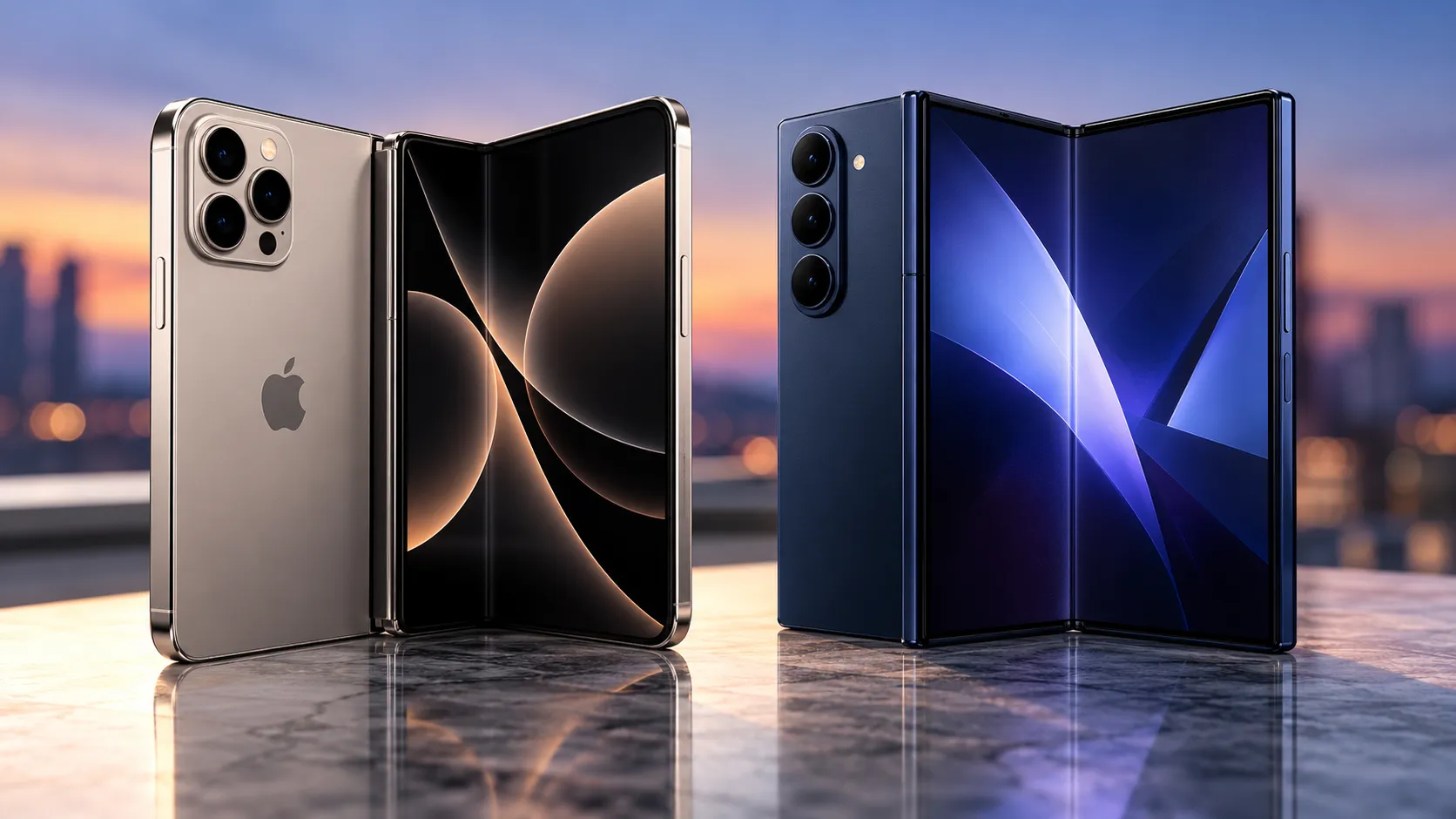
The two devices are worth looking at side by side:
Standard Galaxy Z Fold 8: 158.4 x 143.2 x 4.5mm unfolded, 72.8mm wide when folded, 8-inch inner display, 6.5-inch cover screen
Galaxy Z Fold 8 Wide: 123.9 x 161.4 x 4.9mm unfolded, 82.2mm wide when folded, 7.6-inch inner display, 5.4-inch cover screen
The Fold 8 follows a clear evolutionary path: spec-forward refinement, a camera system rumored to include a 200MP primary sensor with OIS, and a design lineage familiar to existing Fold buyers, SamMobile reported in late March. The Wide Fold inverts the geometry entirely. Shorter and wider, with a dual-camera setup rather than the triple-sensor array on the Fold 8, per PhoneBunch. Whether that camera difference reflects deliberate product segmentation or simply incomplete pre-production data is genuinely unclear. Pricing is similarly unresolved, though one source puts the Wide Fold at around $2,000, roughly in line with the standard Fold 8, PhoneBunch reported.
Both devices are expected to be among the first to ship with One UI 9, based on Android 17, SamMobile noted. The fact that Samsung built the WideFoldModel classification into One UI 9 from early in development not as a later software patch suggests the software team treated the wider device as a first-class hardware category alongside the standard Fold 8 from the start. That's what distinguishes this from a one-off experiment: the architecture was designed around it.
Reports also surfaced last week that Samsung may discontinue Galaxy Z TriFold sales just months after launch, PhoneBunch reported. If accurate, pairing a standard Fold 8 with a wider variant starts to look less like expanding the lineup and more like replacing spectacle with segmentation two practical choices rather than an escalating range of form-factor novelties.
What to watch when Unpacked arrives
The evidence for the Wide Fold is unusually well-structured for an unannounced device: software classification, firmware build numbers, animation assets, a foreign-material-detection feature explicitly coded for it, and first renders all surfacing within roughly six weeks of reporting. The code is the most solid layer; the renders are the most visual. Together, they describe a device in real development, even if final details, branding, and launch timing remain unconfirmed, as both Android Authority and SamMobile have cautioned.
Three things worth watching when Samsung's summer Unpacked event arrives: the actual folded width in real-world handling (82.2mm is a number; 82.2mm in a jacket pocket is an experience), how One UI 9 assigns app layouts on the wider inner panel without user prompting, and whether Samsung leads its marketing with cover screen usability. That last signal would confirm the tall-and-narrow era is finished as a design priority not just trimmed at the margins the way the Fold 7's 21:9 cover screen was, per Samsung's own launch materials.
Foldable success has always depended less on how large a screen measures diagonally and more on whether the device behaves like a phone when closed and a tablet when open. The Wide Fold, if it ships as the evidence suggests, is Samsung's most direct attempt to build a foldable that actually passes both tests.

Comments
Be the first, drop a comment!