





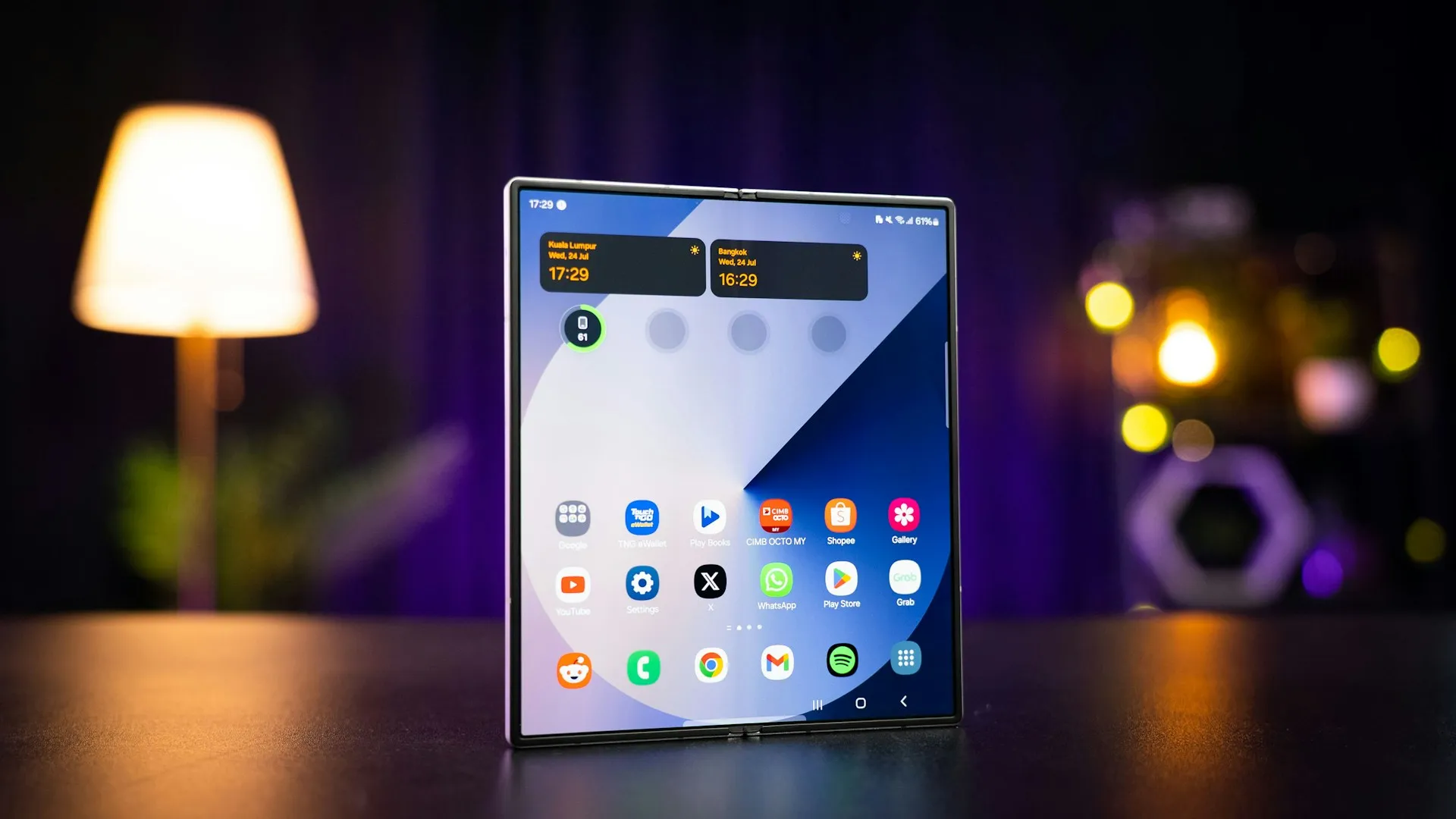
Samsung confirmed at Galaxy Unpacked on July 22, 2026 that its Z8 lineup, the Galaxy Z Fold8, Fold8 Ultra, and Flip8, uses silicon-carbon anode batteries. The Z8 series marks Samsung's first smartphone lineup to adopt the chemistry, which is intended to increase energy density without requiring a proportionally larger battery enclosure.
The Fold8 Ultra was announced with a 5,000mAh typical battery, up about 14% from the Galaxy Z Fold7's 4,400mAh capacity, while keeping a 4.1mm unfolded profile. The standard Fold8 also received a battery increase, moving to 4,800mAh typical from 4,400mAh on the Fold7.
Samsung lists the Fold8 Ultra at 5,000mAh typical and 4,854mAh rated, while the standard Fold8 is rated at 4,800mAh typical and 4,660mAh rated. Both phones support 45W wired charging through a dual-path architecture, according to Samsung's engineering team.
Samsung rates the Ultra to reach 67% in around 30 minutes and the standard Fold8 to reach 63% in the same period under its laboratory conditions. Those figures use a 45W adapter and 3A USB-C cable, starting at 0% with the screen, services, and features turned off.
What's confirmed for the Fold8 and Fold8 Ultra batteries
The important distinction is what's shared between the two phones and what isn't. Both use the new silicon-carbon battery system, 45W wired charging, and Samsung's dual-path charging architecture.
Capacity and charging results differ:
Galaxy Z Fold8: 4,800mAh typical, 4,660mAh rated, up to 63% in around 30 minutes
Galaxy Z Fold8 Ultra: 5,000mAh typical, 4,854mAh rated, up to 67% in around 30 minutes
Both 30-minute charging figures come from Samsung's internal testing with a 45W adapter, 3A USB-C cable, an empty battery, and the phone's screen and services turned off. Actual charging speed can vary with temperature, battery level, charger, and normal device use.
That represents a meaningful upgrade from the Galaxy Z Fold7, which had a 4,400mAh typical battery, 25W wired charging, and a Samsung rating of up to 50% in around 30 minutes.
Real-world charging can differ substantially from the lab figures. In its Galaxy Z Fold8 Ultra review, Android Central measured about a 40% gain in 30 minutes and roughly one hour for a full charge.
Why the Galaxy Z Fold 8 Ultra's 5,000mAh battery got bigger
Silicon has a theoretical specific capacity of roughly 4,200 mAh per gram, compared with about 372 mAh per gram for graphite. That difference is why silicon-based anodes can increase energy density compared with conventional graphite-dominant designs.
Those theoretical numbers don't translate directly into a phone battery's capacity. Commercial silicon-carbon batteries use a mixture rather than a pure silicon anode, and the finished cell also has to account for cycle life, swelling, safety, packaging, and thermal limits.
Samsung attributes the Z8 battery improvements to more than the anode chemistry alone. The company says silicon-carbon increases energy density within the same amount of space, while its Flex Titanium display structure also reduces internal thickness and frees room for components including the battery and cooling system.
Samsung has not disclosed the proportion of silicon used in its anode mixture. That makes it difficult to compare how aggressively Samsung is using the material against competing silicon-carbon implementations based on chemistry alone.
The 5,000mAh Ultra battery is therefore the result of several engineering changes working together rather than a direct measure of how much silicon Samsung put into the cell.
Samsung silicon-carbon battery safety claims still need long-term testing
Silicon anodes have a well-known materials challenge: silicon expands significantly during lithiation and contracts again as the battery discharges. Research literature has documented volume expansion approaching 400% in some silicon-anode conditions, which can damage electrode structure and reduce cycle stability if it isn't controlled.
Samsung says the Z8 battery system was redesigned around that problem rather than simply substituting silicon-carbon for the previous anode.
The company describes changes across the anode, cathode, electrolyte, and separator. Android Central reports that these include a thin carbon coating intended to stabilize the silicon material, cathode coating and doping intended to improve structural stability at higher voltages, electrolyte additives that help protect the silicon surface, and a high-porosity separator designed to support ion flow and thermal stability.
Samsung mobile R&D executive Sunghoon Moon said the company "changed the entire battery system, including the anode, cathode and separator" and tested it across a wide range of scenarios before launch, according to The Korea Times.
Those are Samsung's design and validation claims. Longer-term independent testing will be needed to establish how the new cells behave after hundreds of charge cycles and sustained use.
How the Fold8 Ultra stacks up
The Fold8 Ultra's 5,000mAh battery is a clear improvement over Samsung's Fold7 generation, but it isn't the largest silicon-carbon battery in a current foldable.
Rival foldables such as Motorola's Razr Fold and Vivo's X Fold 5 have reached the 6,000mAh range, giving Samsung less raw capacity despite its move to the newer chemistry.
Raw capacity doesn't determine battery life on its own. Display efficiency, chipset power consumption, software, radios, thermal management, and usage patterns can all change how long a phone lasts away from a charger.
The Fold8 Ultra's real-world battery performance therefore matters more than the chemistry label or 5,000mAh figure by itself.
What buyers should check before deciding
Samsung's published numbers now give both Fold8 models a clear baseline. The standard Fold8 has a 4,800mAh typical battery and a claimed 63% charge in around 30 minutes, while the Fold8 Ultra has a 5,000mAh typical battery and a claimed 67% in the same period. Both support 45W charging.
Samsung's silicon-carbon redesign also has more detail behind it than a simple anode swap, with changes across multiple battery components intended to manage the higher-reactivity material.
Long-term battery health is still the unanswered part. Independent cycle-life data, repeated thermal testing, teardown analysis of the new cell construction, and Samsung's undisclosed silicon ratio would provide a clearer picture of how the chemistry ages over time.
Early charging testing already shows why independent results matter. Samsung's controlled 67%-in-30-minutes result for the Ultra wasn't reproduced in Android Central's review, which measured about 40% in the same period.
For buyers choosing between the two, the standard Fold8 now offers both more battery capacity and faster charging than the Fold7 it replaces, while the Ultra adds another 200mAh and a slightly faster claimed charging curve. Long-term testing will determine whether Samsung's first silicon-carbon Galaxy smartphones deliver the durability gains its redesigned battery system is meant to support.




Comments
Be the first, drop a comment!