





Samsung Galaxy A27 Price Increase: Specs, DeX Leak, and Trade-offs
Samsung's Galaxy A27 goes on sale July 14 at $349.99, a $50 jump over the Galaxy A26 it replaces. Android Police attributes the Samsung Galaxy A27 price increase largely to a RAM shortage, not to meaningful spec improvements. The timing makes the story stranger: when Samsung's Czech Republic website accidentally published the A27's product page two weeks before that report, it listed Samsung DeX as a supported feature. The page came down. DeX has not appeared in any confirmed launch materials since.
Samsung Galaxy A27 DeX leak: what was listed and what disappeared
DeX is Samsung's desktop-mode feature. Connect a compatible phone to an external monitor via USB-C or wirelessly, and the interface expands into a windowed environment with resizable apps, keyboard and mouse support, and a layout designed for large screens. It turns a pocket device into something approaching a workstation. Since its introduction, it has been exclusive to flagship hardware, per Samsung's own support documentation.
That documentation lists DeX-compatible phones as the Galaxy S9, S10, S20, S21, S22, S22+, and S22 Ultra. Tablet support runs from the Tab S4 through the S8 series. The A-series, where Samsung moves most of its volume, has never appeared on that list, according to both Samsung UK and Samsung India support pages.
SamMobile spotted the DeX listing on the deleted Czech page. Android Authority called it "a huge software inclusion" for a device in this price range, and the reaction is easy to understand. The A27 ships with a Snapdragon 6 Gen 3 chip and six years of OS updates. A phone with that longevity commitment and a desktop mode would be a genuinely compelling productivity device for students, remote workers, and anyone trying to make one device do most jobs. The $349.99 price tag reads very differently in that context.
The page came down. Whether the DeX listing was a data-entry error, a feature cut late in development, or a capability scoped to specific regional variants is unknown. What is known is that no formal Samsung launch material has confirmed it. Buyers should treat DeX as absent unless Samsung's official spec sheet says otherwise before July 14.
Galaxy A27 vs Galaxy A26: what the Samsung Galaxy A27 price increase actually buys
The real upgrades deserve credit. Swapping Samsung's in-house Exynos 1380 for the Snapdragon 6 Gen 3 is a genuine step forward. The Exynos chips powering recent A-series phones drew consistent criticism, and Android Authority called the switch "a good course correction" when the leak surfaced two weeks ago.
Six years of OS and security updates, starting on One UI 8.5 with Android 16, is competitive with anything at this price, per Android Authority and Notebookcheck. For someone keeping a phone four or five years, that commitment has measurable dollar value. A device with security patches through 2032 is meaningfully different from one that ages out in two.
The display gets a cosmetic and durability upgrade worth noting. The U-shaped notch from the A26 gives way to a centered hole-punch cutout, and the 6.7-inch FHD+ 120Hz Super AMOLED panel now carries Gorilla Glass Victus+ protection, according to Notebookcheck. The glass upgrade matters for long-term durability in ways that aren't obvious until a phone survives a drop it wouldn't have otherwise.
The 5,000mAh battery charges at 25W and hits up to 45% in 30 minutes, per Notebookcheck. That's identical to the A26.
Storage configurations remain unclear going into launch. The US base model ships with 6GB of RAM and 128GB of expandable storage. European pricing points to a 256GB tier, and earlier leaks indicated an 8GB RAM variant exists, but which configurations land in which markets is unconfirmed, per Android Authority and Notebookcheck. Anyone comparing value directly to the A26 should confirm the specific configuration before drawing conclusions.
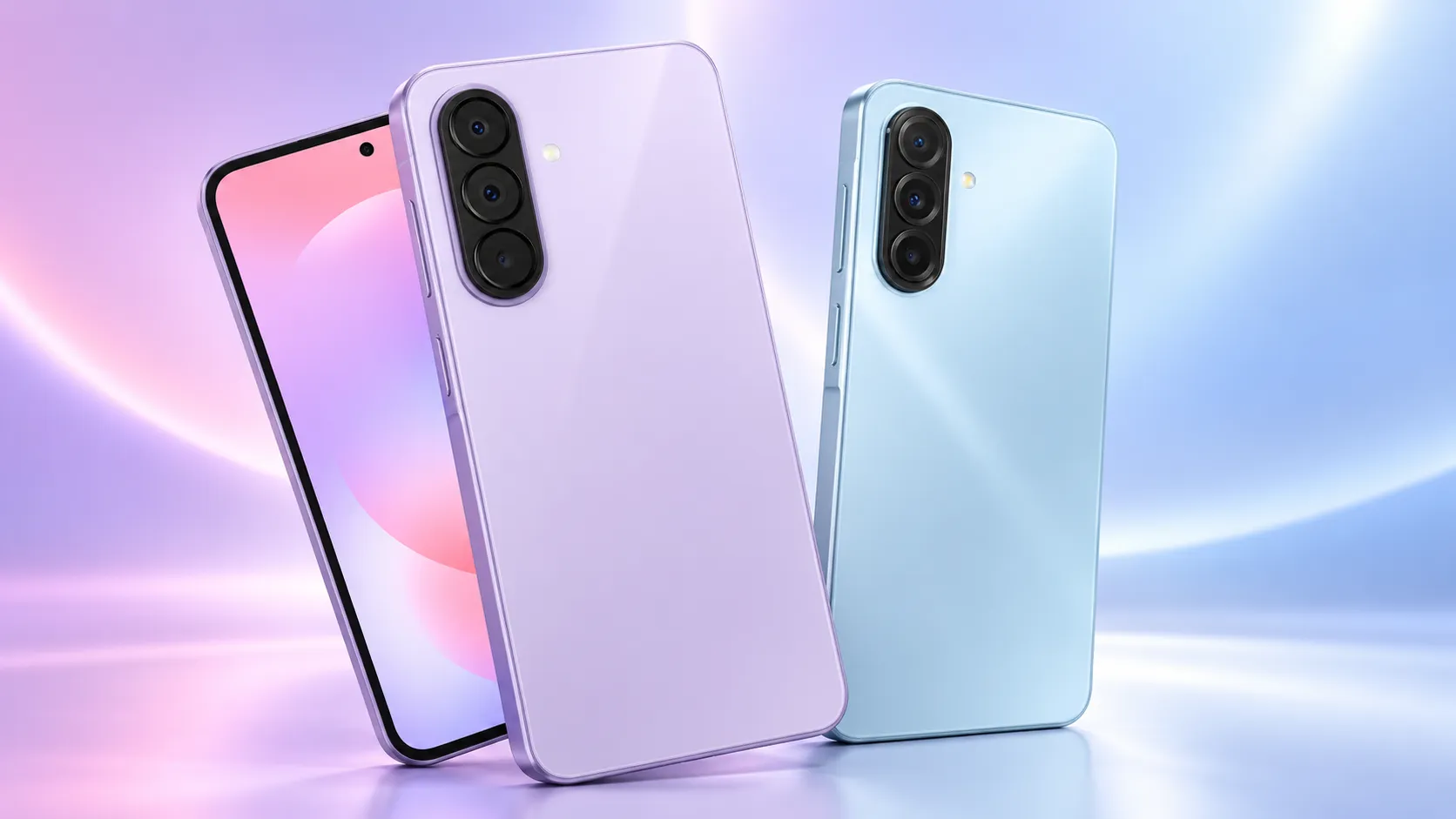
The phone also comes in four color options: Black, Blue, Light Green, and Light Pink, per Notebookcheck. It fits stereo speakers and a side-mounted fingerprint scanner into a 7.7mm frame, according to Android Authority. Quick Share to iOS devices is supported as well.
Where the A27 goes backward
The regressions are concrete and land in areas that affect daily use.
The A26 carried an IP67 rating, meaning it could survive submersion in a meter of water. The A27 drops to IP64, splash resistance only, Android Police reported last week. That gap is practical, not theoretical. IP67 means the phone survives a drop in a sink, a puddle, or a shallow pool. IP64 means it handles rain. Budget phone buyers tend to keep their devices longer and use them harder than flagship buyers, which makes this the worst tier to cut protection.
The secondary cameras also regress. The front camera drops from 13MP to 12MP, and the ultrawide falls from 8MP to 5MP, with the 2MP macro unchanged, per Android Police. Raw megapixel counts don't fully describe image quality, but the ultrawide gap is not trivial. A 5MP ultrawide sensor produces noticeably softer, noisier results in anything other than good light. That covers most real-world shots: group photos, tight interior spaces, outdoor scenes at dusk or in overcast conditions. The main 50MP camera capable of 4K video at 30fps is a genuine asset, per Android Authority. The secondary lenses are where the compromises show.
The core hardware most buyers interact with daily is carried straight over from the A26 at identical specs: the 6.7-inch 120Hz panel, 6GB of RAM, 128GB base storage, 5,000mAh battery, according to Android Police. Samsung improved the chipset and screen glass, but those aren't what the $50 increase is covering. Android Police attributes the majority of the price pressure to a RAM shortage, describing the A27 as one of the first clear victims of that shortage reshaping what budget phones can offer.
The context is broader than Samsung. Apple recently announced price increases on MacBooks and iPads, citing supply cost pressure, with CEO Tim Cook telling the Wall Street Journal that "the situation has become unsustainable," per Android Police. The A27 sits in that same current, just at a price point where buyers have less cushion to absorb it.
For buyers upgrading from an A25 or earlier A-series phone, the chipset, display glass, and software longevity represent a real generational improvement. The trade-off is harder for anyone coming from an A26, where the durability and camera regressions are immediate and measurable while the gains are more abstract.
What to watch before July 14
Two weeks remain before the A27 goes on sale. Samsung's official US spec sheet is where any DeX confirmation would appear.
Android Authority's coverage framed the Czech page's DeX listing as significant enough to reframe the phone's value entirely. If Samsung confirms support before launch, the A27 becomes a harder phone to dismiss at $349.99 a Snapdragon 6 Gen 3 chip, six years of updates, and a desktop mode would be a combination this price range has never offered. If it doesn't appear on the official sheet, the phone is a chipset upgrade and a software longevity bet at a price point where the assumptions buyers have long relied on are no longer holding.
Android Police frames the A27 as evidence that a RAM shortage is reshaping what budget phones can deliver, and the spec sheet supports that reading. Year-over-year improvement across the board was a reasonable expectation for this segment for a long time. The A27 is a case where it stopped being automatic.



Comments
Be the first, drop a comment!