





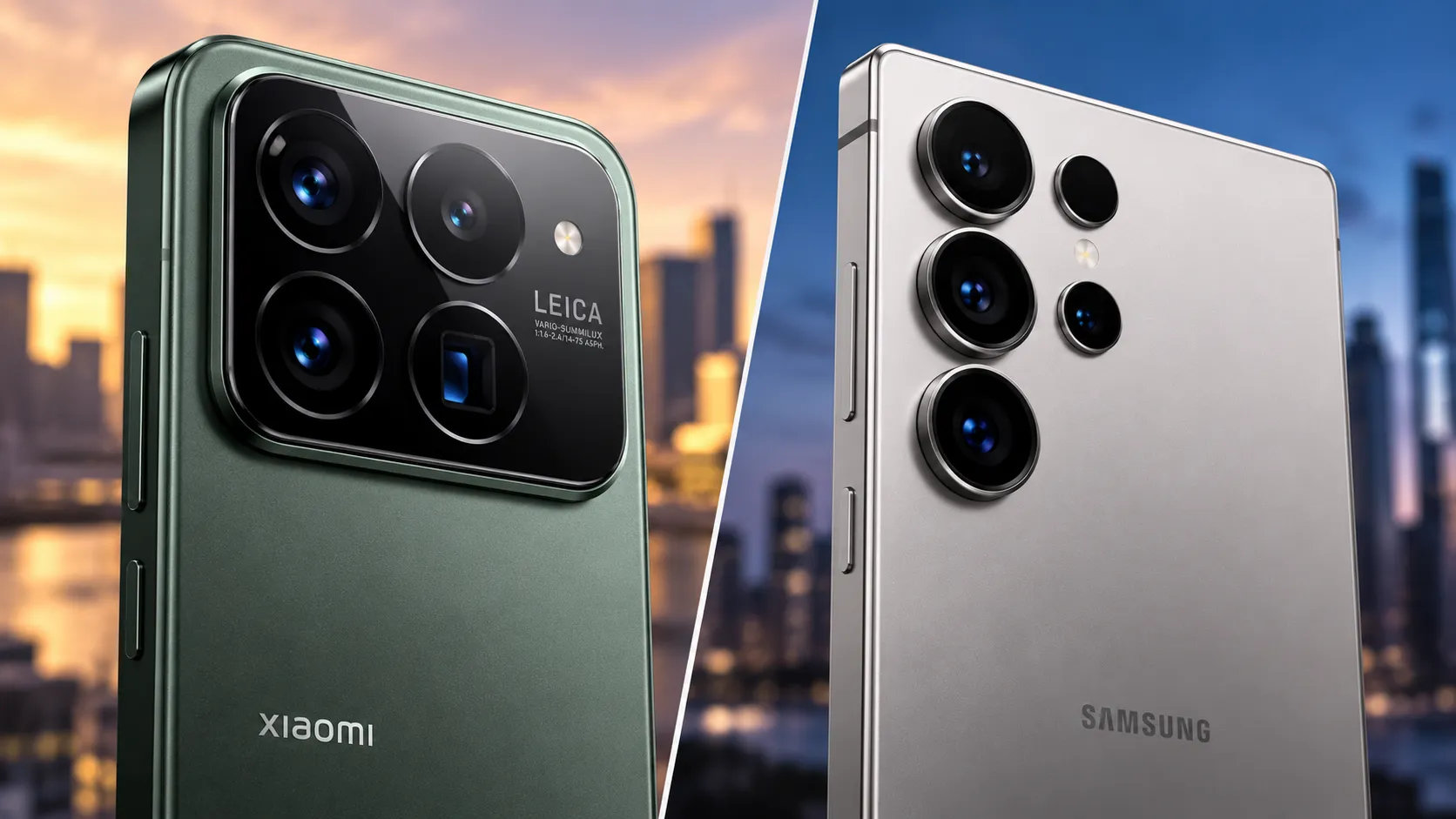
Xiaomi has now launched the 18 Pro and 18 Pro Max in China, locking in the camera hardware that was being teased before their Sept. 23 debut. Samsung, meanwhile, hasn't officially revealed the Galaxy S27 Ultra camera system yet, and leakers are still disagreeing over parts of its telephoto setup.
That makes the Xiaomi 18 Pro vs Galaxy S27 Ultra camera comparison uneven for now. Xiaomi's core camera specifications are official, though independent testing is still limited. The Galaxy S27 Ultra side remains built almost entirely from leaks, and the leakers don't even agree on whether its 5x telephoto sensor is changing, according to Tech Advisor.
This breakdown covers the standard Xiaomi 18 Pro, not the Pro Max, whose light-gathering claims differ and shouldn't be applied to the base model. Whether you're a Galaxy Ultra owner weighing whether to wait for the S27 Ultra, or just curious whether Xiaomi's two 200MP cameras represent a meaningful leap forward, here's what's confirmed, what's still contested, and what to check once the phones can be tested side by side.
Where each phone puts its highest-resolution sensor
Sensor placement, not the megapixel count on a spec sheet, helps determine how a phone handles portraits, indoor medium-zoom shots, and the handoff between different focal lengths.
The Xiaomi 18 Pro uses a 200MP 1/1.28-inch Light Fusion 960L sensor for its primary camera, paired with an f/1.67 aperture, LOFIC HDR, and optical image stabilization. Its telephoto camera also uses a 200MP sensor, though a smaller 1/1.56-inch unit, with a native 75mm focal length equal to 3.2x optical zoom and an f/2.4 aperture, according to Android Authority.
The telephoto also supports focusing from 12cm using a floating-focus design, letting it double as a close-up camera rather than just a portrait and zoom lens.
Samsung, by contrast, is rumored to stick with a single 200MP camera rather than putting high resolution on both the primary and telephoto cameras. That's the structural difference worth watching: Xiaomi is putting a large, high-resolution dedicated sensor at roughly 3x, while Samsung may eliminate its dedicated 3x camera and ask the primary sensor to cover more of the middle zoom range.
Samsung's current Galaxy S26 Ultra helps explain why that matters. Its 3x telephoto remains a 10MP f/2.4 camera, and the S26 Ultra actually moved to a smaller 1/3.94-inch sensor than the S25 Ultra's 1/3.52-inch unit. Xiaomi's 3.2x telephoto takes a very different hardware approach, using a much larger dedicated sensor at approximately the same part of the zoom range.
One important model distinction remains. Xiaomi says the 18 Pro Max telephoto gathers 83% more light than its predecessor. That claim should not be applied to the standard 18 Pro.
The Galaxy S27 Ultra leak fight: what's confirmed, what's disputed
Sorting fact from guesswork matters here because the Xiaomi 18 Pro is now official, while the Galaxy S27 Ultra rumor chain still involves several leakers making partly conflicting claims.
Confirmed for the Xiaomi 18 Pro: a 200MP 1/1.28-inch main camera with LOFIC HDR, a 50MP ultrawide, and a 200MP 1/1.56-inch 3.2x telephoto with 12cm close focusing.
Specific to the Xiaomi 18 Pro Max: Xiaomi's claimed 83% telephoto light-gathering improvement.
Reported for the Galaxy S27 Ultra: recent leaks say Samsung may drop its dedicated 3x telephoto entirely and use a new 200MP ISOCELL HP6 primary sensor to cover more of that range.
Still disputed: Ice Universe has said Samsung will retain its existing 50MP 5x telephoto hardware, including the 1/2.52-inch sensor, while WinFuture's Roland Quandt has reported a 50MP Sony 5x camera instead, according to Tech Advisor.
Not confirmed by Samsung: none of the Galaxy S27 Ultra camera specifications above are official.
The reported removal of the 3x camera has gained additional support in more recent leaks, but the exact 5x hardware remains disputed. Until Samsung announces the phone, those should be treated as separate rumors rather than a finalized camera specification.
Can a new 200MP main camera replace a dedicated telephoto?
Samsung's rumored strategy for the S27 Ultra isn't about fitting a physically bigger main sensor. It's about getting more from a new one.
The company may eliminate its aging dedicated 3x camera and rely on the 200MP primary sensor for that part of the zoom range, while retaining a dedicated 5x telephoto.
The sensor reportedly doing that work, referred to as the ISOCELL HP6, is expected to remain around 1/1.3 inches, the same optical format as the Galaxy S26 Ultra's current HP2. Leaks nevertheless point to improved light sensitivity, HDR performance, highlight control, shadow noise, and color reproduction.
That distinction matters. Sensor size affects light gathering, but it doesn't automatically determine how good an in-sensor crop will look. Crop quality also depends on pixel architecture, lens resolution, exposure handling, autofocus, and image processing.
Close-focus shooting is one specific test case worth flagging. Xiaomi's telephoto focuses from 12cm using dedicated floating optics. It's an open question whether a crop from Samsung's primary camera can offer comparable flexibility at similar framing.
Samsung's own technical materials support the broader idea that a 200MP sensor can cover multiple focal lengths. Its Tetra²pixel system can retain a 12.5MP output while performing up to 4x in-sensor zoom, according to Samsung Semiconductor.
That's a genuine capability of Samsung's 200MP sensor technology, but it's still company positioning about the sensor category rather than an independently tested result from the unreleased Galaxy S27 Ultra.
Whether Samsung's implementation holds up in practice remains open. Phones in the vivo X300 and OPPO Find X9 families already support multi-frame processing at full 200MP resolution, enabling high-resolution portraits and night shots with more sophisticated processing than earlier 200MP cameras.
A comparison from earlier this year shows why physical specifications still need real-world context. The vivo X300 Ultra's 200MP main camera uses a 1/1.12-inch Sony sensor, compared with the 1/1.3-inch ISOCELL HP2 in the Galaxy S23 Ultra. Android Authority found substantially more detail from the vivo in its comparison.
That test also involved a 35mm focal length on the vivo versus 24mm on the Samsung, which complicates any attempt to attribute the difference entirely to sensor size. It's a useful illustration of why sensor size, optics, focal length, and processing have to be judged together, not proof that either approach will win the Xiaomi 18 Pro vs Galaxy S27 Ultra matchup.
What actually separates a good 200MP camera from a marketing number
Resolution alone doesn't tell buyers much.
TechInsights completed a technical comparison of Samsung's ISOCELL HP5, Sony's LYT-901, and OmniVision's OV52A, three current 200MP sensor designs, and found substantial architectural differences despite the shared resolution number, according to TechInsights.
Sony's LYT-901 uses a 0.70-micron pixel pitch along with dual conversion gain HDR and hybrid frame HDR processing. OmniVision's OV52A uses a 0.61-micron pixel pitch and a 1/1.28-inch optical format. Samsung's HP5 takes another approach with smaller pixels and its own binning, autofocus, and light-gathering technologies.
That's a comparison of sensor architecture and design choices, not a ranked verdict on which sensor takes better photos. Real-world image quality still depends on the lens, processing pipeline, autofocus system, stabilization, and software tuning built around each part.
That distinction matters directly for the Xiaomi 18 Pro vs Galaxy S27 Ultra comparison. Xiaomi has confirmed the size and basic optical specifications of its cameras, but the exact performance of the finished system still needs independent testing. Samsung hasn't even confirmed the HP6 or the final telephoto configuration yet.
The megapixel number alone won't tell you how either phone handles HDR scenes, autofocus speed, moving subjects, skin tones, or fine detail at intermediate zoom levels.
This is also why lumping the Xiaomi 18 Pro Max in with the standard 18 Pro against Samsung's flagship oversimplifies the comparison. Xiaomi specifically attributes the 83% telephoto light-gathering improvement to the Pro Max, so that figure shouldn't be used to describe both models.
Before comparing samples, check these specifics
The Xiaomi 18 Pro's core camera hardware is now official, but Samsung's HP6 sensor, reported removal of its 3x camera, and disputed 5x hardware remain leaks with no official confirmation.
Once the Galaxy S27 Ultra launches and independent reviewers can test the phones under matched conditions, a handful of checks will separate a real camera upgrade from a spec-sheet win:
Confirm whether Samsung actually removed the dedicated 3x lens and is relying on the main sensor for that zoom range.
Check the physical sensor size and pixel pitch Samsung announces for the HP6, not just the 200MP resolution.
Look for matched-condition indoor portrait samples at 3x, 4x, and 5x, ideally including moving subjects and close-focus shots where autofocus performance becomes obvious.
Compare shutter speed, fine-detail retention, skin tones, HDR handling, and consistency throughout the middle zoom range.
Test Xiaomi's 12cm telephoto focusing against whatever close-focus capability Samsung provides around equivalent framing.
For now, Xiaomi has the clearer hardware story because its specifications are shipping rather than rumored. That still doesn't establish which phone will take better pictures.
The comparison will only become meaningful once Samsung reveals the Galaxy S27 Ultra and independent reviewers can put both camera systems through the same scenes.


Comments
Be the first, drop a comment!