





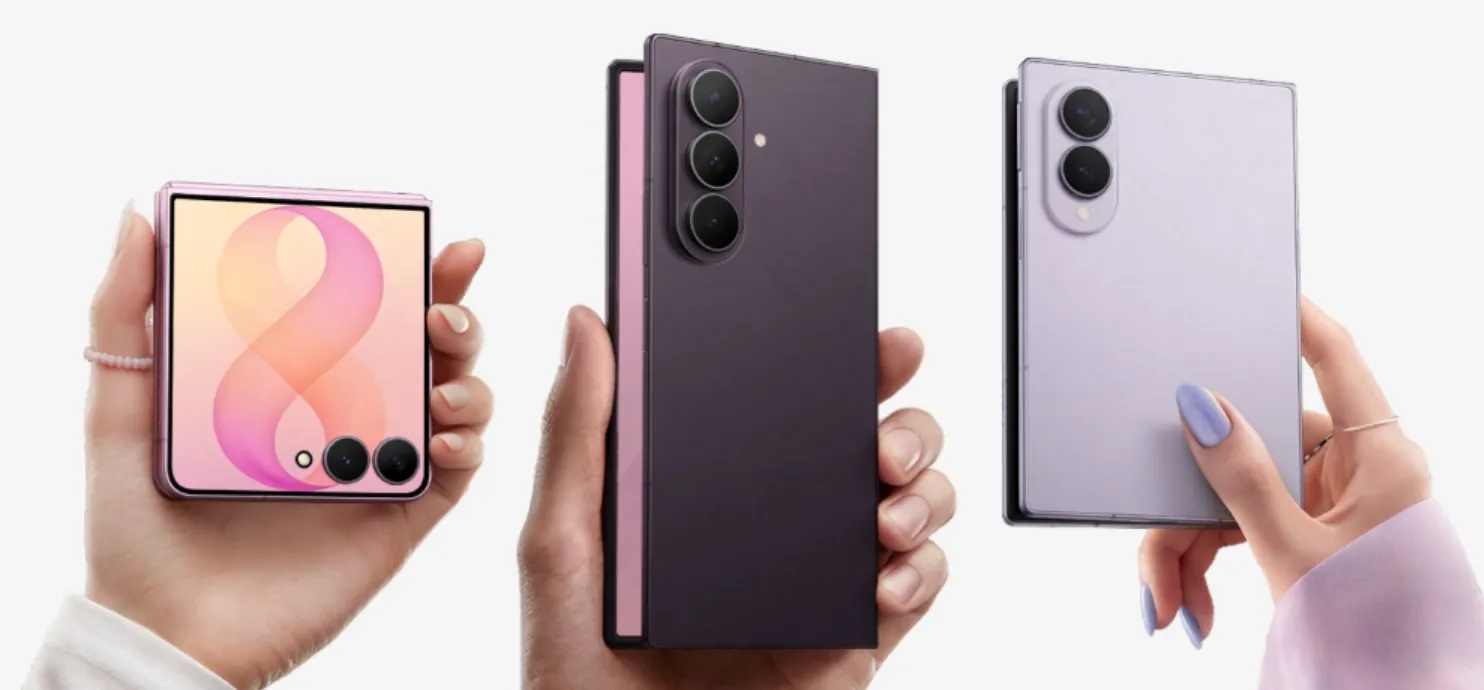
Samsung confirmed that the Galaxy Z Fold 8, Galaxy Z Fold 8 Ultra, and Galaxy Z Flip 8 all ship with silicon-carbon batteries, making them the first Galaxy phones to use the chemistry, per Android Authority. The disclosure didn't come from a keynote slide or a press release. It came out in Q&A at a media briefing.
What Samsung confirmed: the same silicon percentage across all three foldable models, longevity on par with previous generations, and a full rework of the battery system beyond the anode material itself.
What it didn't confirm: the actual silicon percentage, whether the silicon-carbon chemistry itself contributes to faster charging, or any durability gains over prior generations. Every performance claim in circulation right now originates from Samsung's own briefings or pre-release promotional materials. Independent reviewers haven't run these devices through real-world conditions yet.
Why foldables have a battery problem flat phones don't
The hinge mechanism and folding display in a foldable phone consume internal volume that a conventional slab design can dedicate to a larger cell. Engineers building foldables face a constraint their counterparts on conventional phones don't have to solve in the same way: the form factor itself limits how much battery chemistry can help.
That tradeoff has been visible in capacity figures for years. The Z Fold 8 Ultra jumps to 5,000mAh with up to 27 hours of video playback, the standard Z Fold 8 reaches up to 26 hours, and the Z Flip 8 carries a 4,300mAh cell, according to Samsung's official specifications. The Z Fold 8 Ultra's jump from 4,400mAh makes more sense once silicon-carbon enters the picture.
Silicon-carbon anodes improve energy density relative to conventional graphite, which is their core appeal for a device category where internal space is a structural constraint. Samsung described the outcome as "not just a larger battery in a thinner body" but a full system redesign engineered "from the material level to deliver higher capacity, stable performance and long-term reliability within a slimmer, stronger foldable form factor."
What Samsung confirmed about the Galaxy Z8 lineup silicon-carbon batteries
Samsung confirmed the chemistry at both a media briefing and a media roundtable. The silicon percentage is identical across all three foldable models, though the company declined to disclose the actual figure, citing confidentiality.
That omission has practical consequences. Silicon-carbon batteries span a wide spectrum. A formulation with modest silicon content behaves very differently from a high-silicon composite, in terms of energy density gains, thermal behavior, and how the cell expands and contracts during charge cycles. Without the percentage, there's no way to compare Samsung's implementation against competitors who have been more forthcoming with their specs.
Samsung did not say whether silicon-carbon chemistry was responsible for the charging changes. The Fold8 Ultra separately adds 45W dual-path charging.
On longevity, Samsung stated that charging cycle performance and battery lifespan remain consistent with previous generations, meeting its highest internal standards for safety, longevity, and stability. That's a parity claim, not an improvement claim. No change to charging speed was announced either.
The Galaxy Watch Ultra 2 reportedly also benefits from a silicon-carbon battery, which could make it Samsung's first wearable with the technology. That detail carries more uncertainty than the phone confirmations and is best read as an early signal of broader rollout rather than a firm announcement.
The engineering Samsung had to solve before this was possible
Samsung was explicit that this was not a materials swap. Making silicon-carbon reliable at scale required reworking the broader battery system, including electrolyte composition, separator design, cell structure, expansion control, and structural integrity.
The underlying problem is physical. Silicon expands and contracts more dramatically than graphite during charge and discharge cycles, creating mechanical stress that can degrade a cell faster if it isn't carefully engineered around. The silicon percentage in the anode isn't just a marketing spec; it's the central design variable that determines whether the cell is energy-dense enough to be worth using and stable enough to be safe over time.
Samsung senior executive Sunghoon Moon addressed this directly: "What we can say for sure is that we dedicated a lot of our energy and resources in order to optimize the percentage of silicon in our silicon-carbon battery." That optimization, calibrating silicon content high enough to meaningfully improve energy density while keeping expansion behavior manageable, is precisely why the percentage remains confidential. It's the hardest part of what Samsung spent years solving.
Applying an identical silicon percentage uniformly across three distinct foldable models, rather than trialing the chemistry in a single premium device, suggests the manufacturing process is mature enough to support volume production across different cell sizes and chassis designs. Samsung also described the work as going back to "the material level" of the battery system, a framing that reads as deliberate given the company's reputational sensitivity around battery safety since the Note 7 recall.
What silicon-carbon does and doesn't change for Z8 buyers
The concrete payoff is capacity without a corresponding increase in physical size. Samsung's own framing describes a larger battery achieved within a slimmer form factor, and the capacity figures are backed by leaked promotional materials. For a device category where internal space has historically set a hard ceiling on capacity, gaining 600mAh in the Z Fold 8 Ultra without expanding the chassis is a real result.
Higher capacity is a necessary condition for longer runtime, not a guarantee of it. Display efficiency, processor load, software behavior, and usage patterns all shape how far a charge gets in practice. The capacity figures give independent reviewers a meaningful baseline to test against, but the gap between spec-sheet hours and lived experience is what those tests exist to close.
What the confirmed data doesn't support is also worth stating plainly. Samsung did not claim that silicon-carbon chemistry itself enables faster charging. The Fold8 Ultra does, however, add officially announced 45W charging. The company did not claim silicon-carbon improves long-term battery durability relative to previous generations. The parity statement on longevity sets a floor, not a ceiling.
What testing still needs to settle
The capacity and charging specifications are confirmed. Their real-world effects remain untested.
Battery life comparisons against the Z Fold 7 in controlled real-world conditions will establish whether the capacity gains translate to longer runtime or get absorbed by display and processor demands.
Thermal behavior under sustained load, including extended gaming sessions, video calls, and navigation, will indicate whether silicon-carbon's expansion characteristics during charge cycles introduce heat patterns not present in prior generations. Long-term degradation data, unavailable until months of actual use accumulate, will determine whether Samsung's parity claim on longevity holds outside controlled internal testing.
The uniform silicon percentage across three foldable models is the clearest indicator that this is a platform-level commitment, per Android Authority. Whether that commitment eventually reaches the Galaxy S series or Galaxy A devices remains unconfirmed. For now, the Z8 lineup is where Samsung has staked its claim. Independent testing will determine whether the performance follows the chemistry.


Comments
Be the first, drop a comment!