




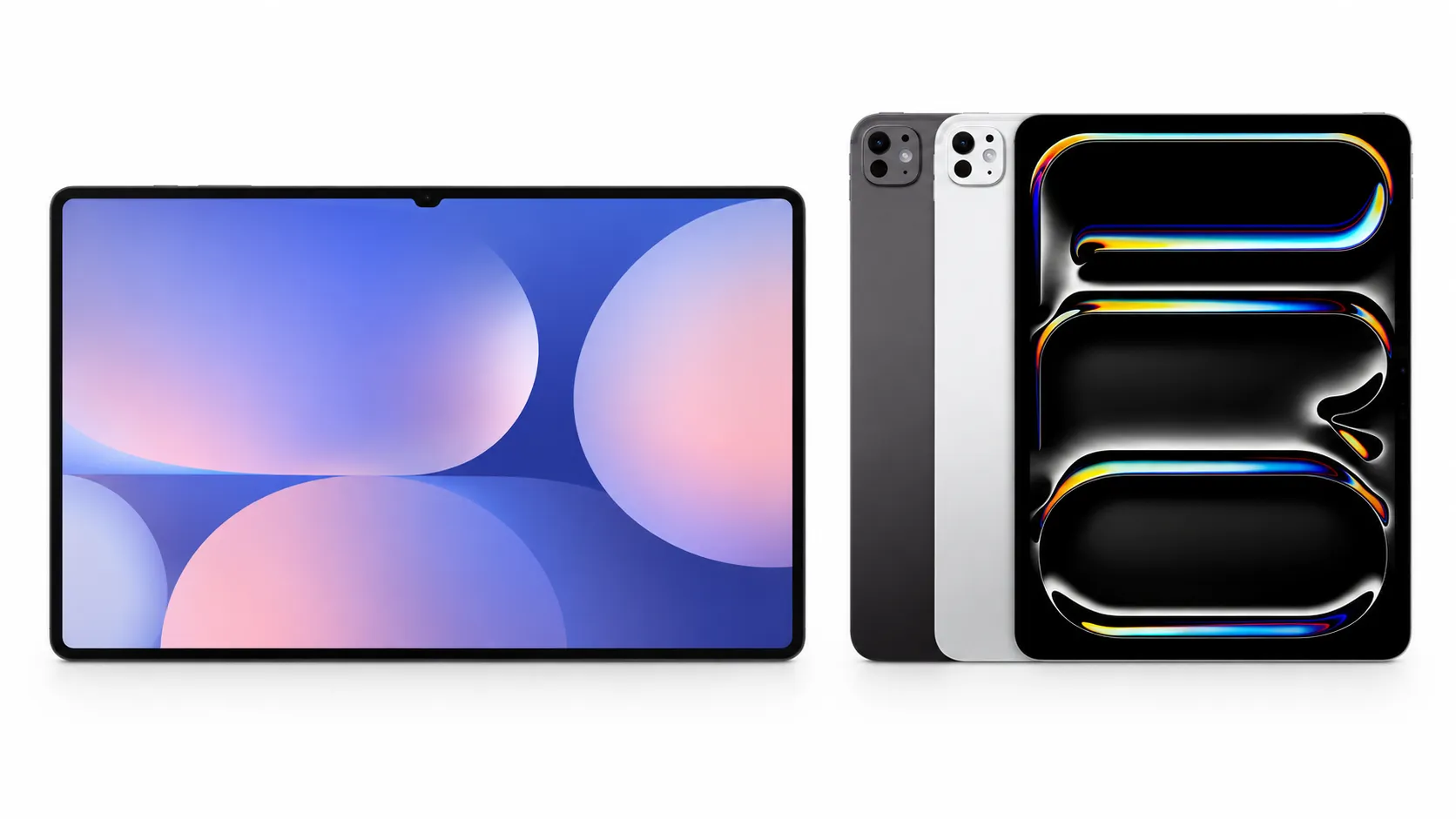
Samsung is going bigger again with the Galaxy Tab S12 Ultra, a 14.6-inch Android flagship built around a massive OLED display, an included S Pen, expandable storage, and desktop-style multitasking. Samsung will release the tablet in the US on Oct. 7, 2026, putting it directly against Apple's 13-inch iPad Pro M5 at the top of the premium tablet market.
The two tablets cost laptop money, but they make different compromises. Samsung gives you more screen and more hardware flexibility, while Apple's smaller tablet is considerably lighter and leads current performance and battery testing. If you're choosing between them, the better buy comes down to whether you value raw speed and portability or Samsung's larger, more customizable setup.
Galaxy Tab S12 Ultra vs. iPad Pro: Which has the better display?
Samsung's biggest selling point is right in front of you. The Tab S12 Ultra uses a 14.6-inch Dynamic AMOLED 2X display with a 2,960 x 1,848 resolution and refresh rate of up to 120Hz. That extra space works well for split-screen apps, drawing, watching video, and keeping several tools visible at once.
Apple's 13-inch iPad Pro uses a tandem OLED Ultra Retina XDR display with a 2,752 x 2,064 resolution and adaptive 10Hz-to-120Hz ProMotion refresh rate. Both displays support up to 1,600 nits of peak HDR brightness under Apple's and Samsung's respective test conditions.
Independent testing shows that neither screen simply beats the other. In Tom's Guide's Galaxy Tab S12 Ultra review, Samsung reached 862 nits in SDR and 916 nits in HDR, while the iPad Pro M5 measured 561 nits and 965 nits, respectively. Samsung's panel also produced more saturated colors, while the iPad's measurements landed closer to natural color targets.
The bigger difference may be how the tablets feel in your hands. Both are 5.1mm thick, but the 13-inch Wi-Fi iPad Pro weighs 579 grams versus 692 grams for Samsung's Wi-Fi model. A 113-gram gap is hard to ignore if you regularly read, draw, or watch video while holding the tablet.
The iPad Pro pulls ahead on performance and battery
Samsung equips the Tab S12 Ultra with MediaTek's Dimensity 9500, while Apple uses its M5 chip. Both have plenty of power for web browsing, streaming, gaming, and everyday multitasking, but current tests show a clear gap once workloads get heavier.
Tom's Guide recorded Geekbench 6 scores of 4,155 single-core and 16,517 multi-core for the iPad Pro M5, compared with 3,229 and 9,763 for the Tab S12 Ultra. The iPad also scored 9,934 at 59 frames per second in 3DMark Wild Life Extreme Unlimited, while Samsung reached 6,608 at 39.7 fps.
Those differences matter most for demanding games, video work, 3D applications, and other processor-heavy tasks. They are less consequential if most of your time is spent in Chrome, streaming apps, note-taking tools, or standard Android apps.
Apple also lasted longer in the same publication's web-browsing battery test. At 150 nits over Wi-Fi, the iPad Pro ran for 13 hours and 16 minutes, versus 11 hours and 31 minutes for Samsung.
Samsung separately rates its 11,600mAh battery for up to 23 hours of local video playback. That's useful context, but it is not directly comparable with a continuous web-browsing test.
There is also a small but practical difference in the box. Samsung includes the S Pen and a USB-C cable but no wall charger. Apple includes a USB-C cable and a 20W USB-C power adapter.
Samsung gives you more room to customize
Samsung makes the stronger case if you want to expand or reconfigure your tablet over time. The S Pen is included, and the Tab S12 Ultra supports microSD cards up to 2TB on top of its built-in storage.
The iPad Pro does not support expandable storage. Apple offers 256GB, 512GB, 1TB, and 2TB configurations, while Apple Pencil Pro remains an extra purchase.
Samsung DeX is another major distinction. It lets you open, resize, and arrange multiple apps in a PC-like workspace directly on the tablet. An external display can extend that experience further, though Android tablet apps still vary in how well they adapt to desktop-style use.
Multi Window also makes better use of Samsung's 14.6-inch screen when you want several apps visible at once. That flexibility suits people who like tweaking their workspace rather than sticking to a single full-screen app.
Apple has loosened up iPad multitasking with iPadOS 26, including more flexible windows and stronger file management. Its advantage is less about customization and more about its mature tablet software library, including apps such as Final Cut Pro, Logic Pro, and Procreate.
Samsung is closing some of that creative-app gap as well. Its current Tab S12 lineup supports Android tablet apps including Photoshop, Notability, Goodnotes, and Clip Studio Paint.
The real price depends on what you add
The 13-inch iPad Pro M5 starts at $1,299 in the US Apple's launch pricing also puts Apple Pencil Pro at $129 and the 13-inch Magic Keyboard at $349. Add both to the base tablet and the total climbs to $1,777 before tax.
The Tab S12 Ultra starts at $1,399, but its S Pen is already included. Samsung sells its keyboard separately, so either device gets considerably more expensive if you plan to turn it into a laptop-style setup.
Samsung also gives you IP68-rated water and dust resistance and microSD expansion without another accessory. The company promises up to seven generations of operating system upgrades and security updates for the Tab S12 series.
Price alone therefore doesn't settle the comparison. Apple's tablet starts cheaper, but Samsung bundles one accessory that many buyers would otherwise have to add.
Which tablet should you buy?
Choose the iPad Pro M5 if you care most about performance, battery life, portability, or Apple's tablet app ecosystem. It is significantly faster in current benchmark testing, lasted longer in the comparable battery test, and weighs 113 grams less than the Galaxy Tab S12 Ultra.
Choose the Galaxy Tab S12 Ultra if the 14.6-inch screen is the attraction, or if you want an included stylus, microSD expansion, IP68 protection, and Samsung's more flexible DeX and Multi Window tools. It also makes the most sense if you already use a Galaxy phone and prefer Android's greater freedom to customize how you work.
There isn't one winner for every buyer. Apple packs more performance into the lighter device, while Samsung gives you more room — both on the screen and in how you can configure it. For most buyers chasing the fastest premium tablet, the iPad Pro M5 is the safer pick. For Android power users who will actually use the S Pen, expandable storage, and that enormous display, the Tab S12 Ultra offers things Apple's flagship simply doesn't.

Comments
Be the first, drop a comment!