





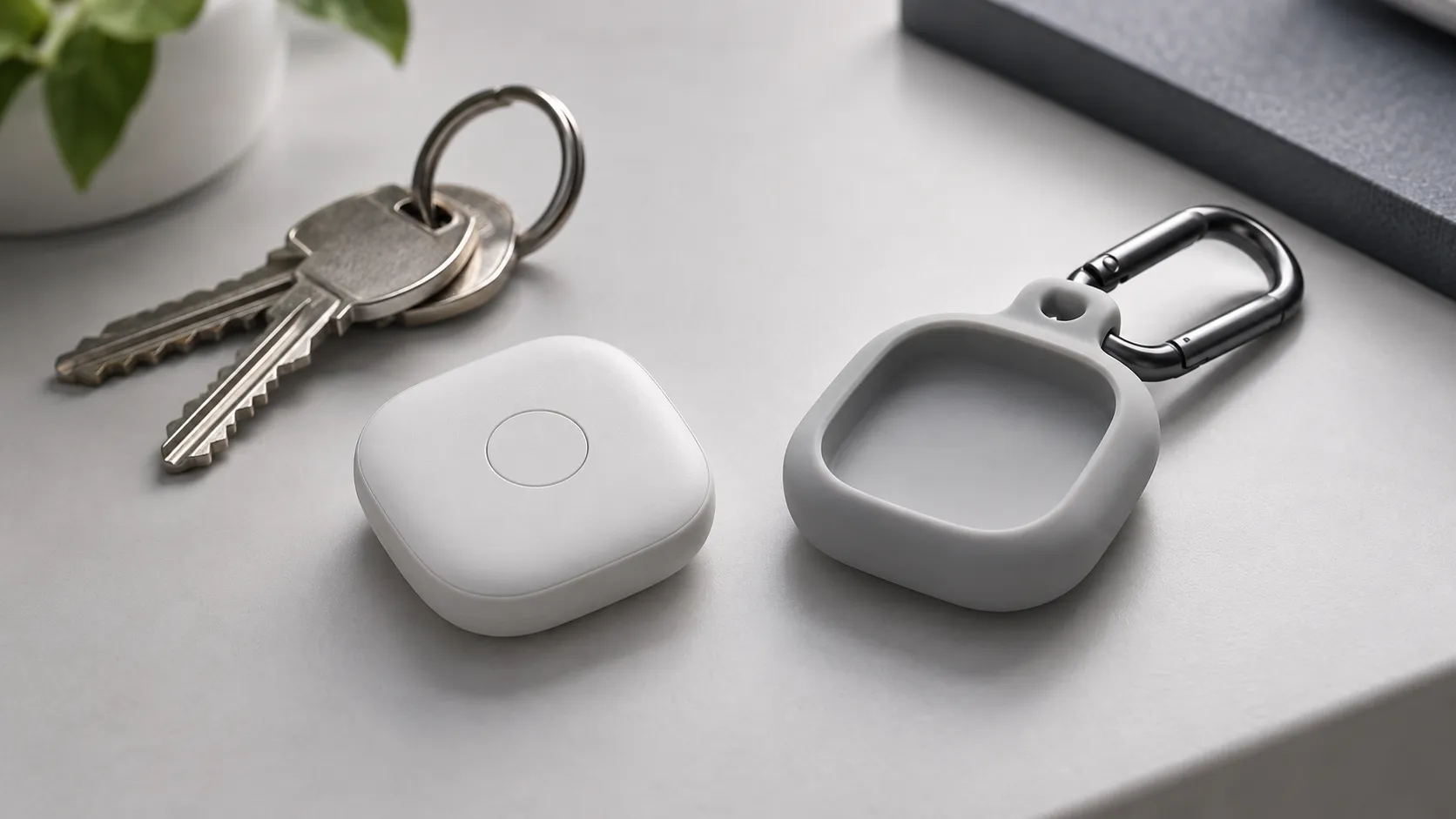
The Samsung Galaxy SmartTag 3 leak that surfaced on September 11 centers on one detail that changes how the tracker works in daily use: the built-in loop for a keyring, carabiner, or lanyard appears to be gone.
Leaked press renders show a compact squircle body with no cutout at all, a design choice both previous Galaxy SmartTag generations avoided, according to 9to5Google and SamMobile.
The renders, originally published by WinFuture and separately supported by other leaks, show a roughly 30 x 30mm body under 10mm thick in white and black finishes.
Regulatory filings provide the strongest independent evidence that the product itself is real. FCC records identify model EI-T5900 as Galaxy Smart Tag3 and confirm Bluetooth Low Energy and Ultra-Wideband radios.
Samsung itself still hasn't announced the Galaxy SmartTag 3, its retail availability, or a launch date.
The missing loop may also be less costly than it first appeared. WinFuture reports that Samsung apparently plans to include a simple case with a carabiner, alongside separate bumper, silicone, leather, and pet-collar accessories.
That box content isn't officially confirmed yet, but it changes the main question from "Will every buyer have to pay extra to attach it?" to "Does Samsung actually ship the leaked carabiner case in every retail package?"
Until Samsung answers that, current SmartTag 2 owners should treat the squircle redesign as a clear change in attachment method rather than a confirmed downgrade.
Galaxy SmartTag 3 Leaked Images: What's Confirmed and What Isn't
The design change is the best-supported part of the leak.
Multiple reports using what appear to be official Samsung marketing images show the SmartTag 3 without the metal-lined cutout that lets the SmartTag 2 attach directly to a keyring.
Most of that design reporting traces back to the same small group of leak sources, however, so the images aren't equivalent to an official Samsung specification sheet.
FCC certification is stronger evidence.
The filing for model EI-T5900 confirms Bluetooth LE and UWB, the same two radio technologies used by the SmartTag 2.
Samsung's FCC documentation also identifies the product as Galaxy Smart Tag3, moving the device itself beyond the stage of a name supplied only by leakers.
The approximately 30 x 30mm dimensions are less direct. WinFuture estimates the size partly from FCC antenna documentation and the leaked marketing materials, with thickness reportedly below 10mm.
Several other specifications remain less certain.
Some leak reporting lists IP67 water and dust resistance and around 500 days of battery life, but neither figure has been confirmed by Samsung as a SmartTag 3 specification.
That's worth keeping separate from the SmartTag 2, which Samsung officially rates at IP67 and up to 500 days of typical battery life, with longer operation possible in Power Saving Mode.
The physical center button is also visible in the leaked design. Earlier reporting says it could retain functions similar to the SmartTag 2, such as ringing a connected phone or triggering a routine.
Until Samsung publishes the user manual or product page, the exact programmable-button behavior should remain provisional.
Galaxy SmartTag 3 vs. SmartTag 2: Attachment, Size, and Tracking Hardware
Attachment is where the redesign changes most.
The Galaxy SmartTag 2 has a large integrated loop built directly into its body. A keyring or similar attachment can connect without putting the tracker inside another case.
The SmartTag 3 renders show nothing equivalent.
Instead, WinFuture reports that Samsung has designed a separate basic case with a carabiner and apparently intends to include one with the tracker.
If that proves accurate, buyers won't necessarily need to purchase an accessory just to put a SmartTag 3 on a set of keys.
The tradeoff is still real, though. The attachment point would now be part of a removable case rather than the tracker itself.
Samsung is also reportedly preparing bumper, silicone, and leather cases, while a Spigen-developed ComforTag accessory would mount the tracker to a pet collar.
The smaller, symmetrical body may be easier to tuck into a bag pocket or other tight space than the SmartTag 2's longer pill shape.
That's a plausible benefit based on dimensions, not a proven wallet advantage. At roughly 30mm square and close to 10mm thick, it would still be substantially thicker than a credit card.
No independent reviewer has tested the final hardware in a wallet yet.
On the tracking side, the FCC documentation confirms that SmartTag 3 retains UWB alongside Bluetooth LE.
That should preserve the hardware needed for more precise nearby finding, but Samsung hasn't published the final SmartTag 3 compatibility list or feature requirements.
For comparison, Samsung's current SmartTag 2 documentation says Compass View requires a UWB-enabled Galaxy phone running Android 11 or later.
Anyone buying the new tracker specifically for precision finding should check Samsung's eventual compatibility page rather than assume every Galaxy phone will support the UWB experience.
The right design therefore depends on how the tracker gets used.
Keychains, luggage, and bag straps benefited from the SmartTag 2's built-in loop. The SmartTag 3 appears to trade that for a smaller body and a case-based attachment system.
Whether that feels like a loss depends heavily on whether the leaked included carabiner case actually ships in the box.
Samsung SmartTag 3 Price Leak, Accessories, and Release Timing
Several leaked accessories now appear in retailer or supplier listings.
Reported options include:
A basic case with a carabiner.
Bumper cases.
Silicone cases.
Leather cases.
A Spigen-linked ComforTag pet-collar mount.
The important distinction is that WinFuture says a simple carabiner case apparently comes with the tracker, while the other cases are separate accessory options.
Samsung hasn't published official box contents, so that should still be verified when the retail listing goes live.
US pricing is more consistent than the original leak coverage made it appear.
A distributor listing reported by SammyGuru shows:
One SmartTag 3: $29.99
Four-pack: $99.99
Those are retailer or distributor figures, not Samsung-announced prices.
European reports point to a different regional structure. WinFuture says a single unit is expected to cost €39.99 in Germany, while separate European reporting has placed a four-pack at around €139.99.
Those figures shouldn't be treated as conflicting US four-pack prices. They're different markets and currencies.
Release timing remains unconfirmed.
Earlier rumors tied SmartTag 3 to Samsung's late-summer hardware launches, but the tracker didn't appear alongside the Galaxy S26 FE.
WinFuture now expects the SmartTag 3 to reach the market in early October, while other outlets describe the launch only as coming within the next few weeks.
As of September 23, Samsung still hasn't announced an exact date.
The FCC approval, South Korean radio certification, leaked marketing renders, US sales SKUs, and accessory listings all point to a product that's far along in the release process. They don't provide an official launch date.
What the Battery and Durability Leaks Actually Tell Us
Battery life is one area where it's easy to accidentally mix SmartTag 2 specifications into SmartTag 3 coverage.
Samsung officially rates the SmartTag 2 for up to 500 days under its typical-use testing, using a replaceable CR2032 battery.
The SmartTag 3's leaked rear design appears to retain access to a coin-cell battery, but Samsung hasn't published its battery type or official endurance rating.
Some reporting gives the SmartTag 3 an approximately 500-day figure, but that remains a leak rather than a Samsung-confirmed specification.
The same caution applies to IP67.
SmartTag 2 officially carries an IP67 rating. Leak reporting says SmartTag 3 may retain it, but Samsung hasn't yet published a SmartTag 3 durability rating.
Until the official specification page appears, don't assume those two numbers carried over unchanged simply because they're familiar from the previous model.
What SmartTag 2 Owners and Prospective Buyers Should Do Now
Buying decisions still split cleanly by how the tracker gets used.
Keychain, backpack, or luggage users: Wait for Samsung's retail listing to confirm that the basic carabiner case really ships in the box. If it does, the missing integrated loop becomes more of a design tradeoff than an added mandatory expense.
Wallet or interior-pocket users: The compact squircle shape may work in your favor, but its roughly 10mm thickness means "smaller" doesn't automatically mean wallet-friendly. Wait for hands-on testing.
Current SmartTag 2 owners: A redesigned body isn't a reason to upgrade by itself. UWB and Bluetooth are already present on the current model, while SmartTag 3 battery life, durability, software improvements, and final accessory bundle remain unconfirmed.
Before spending money at launch, confirm three things.
First, check whether your Galaxy phone supports the SmartTag 3's UWB precision-finding features.
Second, confirm the retail box contents so you know whether the leaked carabiner case is actually included.
Third, check Samsung's official price in your market rather than treating leaked US and European figures as interchangeable.
The missing loop is real in the leaked design. What it costs buyers in practice may be much smaller than it initially appeared if Samsung really does put the basic mounting case in the box.





Comments
Be the first, drop a comment!