



Samsung's push into extended reality goes far beyond the Galaxy XR headset that grabbed headlines recently. What's really compelling is how the tech giant is quietly developing a comprehensive smart glasses ecosystem as its latest addition to wearable computing. While everyone's been focused on their $1,799 Galaxy XR headset launch, Samsung has been working on something potentially more revolutionary—multiple variants of XR glasses designed for everyday wear.
The company's partnership with Google and Qualcomm has created what industry insiders are calling a unified ecosystem approach that extends far beyond competing with Meta's successful Ray-Ban partnership. This represents a strategic bet on creating an entirely new category of ambient computing devices that could accelerate the transition from smartphones to seamless, hands-free digital interaction.
Samsung's dual-track XR glasses strategy
Here's where Samsung's approach becomes strategically fascinating. The company isn't just developing one pair of smart glasses—they're reportedly working on multiple XR glasses variants that target completely different market segments and price points. This mirrors their successful smartphone portfolio strategy, but applied to an entirely new wearable category.
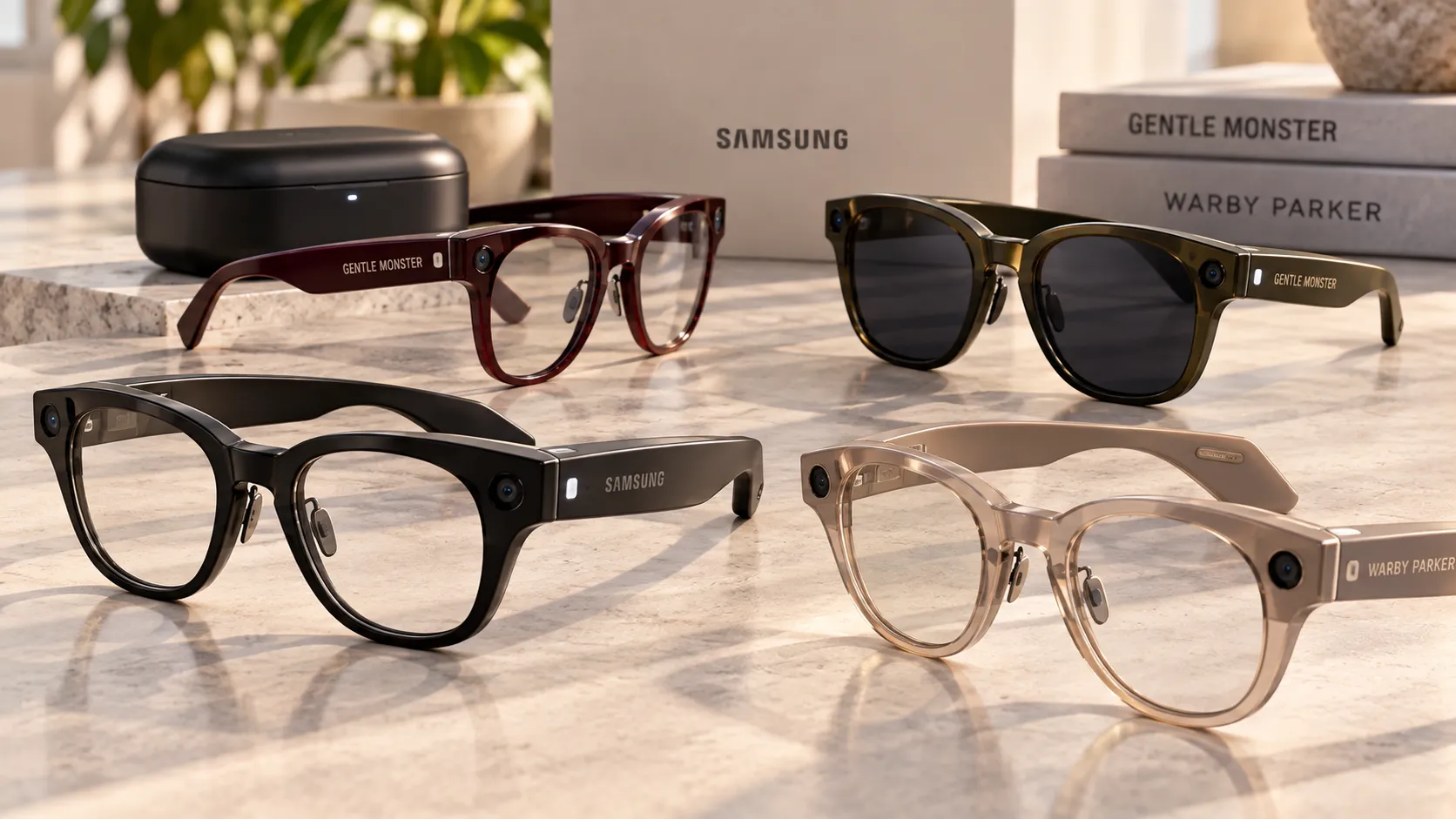
The dual-brand partnership strategy reveals Samsung's sophisticated market positioning. They're rumored to be collaborating with Gentle Monster for fashion-forward, premium designs and Warby Parker for mainstream consumer appeal. This approach addresses two critical barriers to smart glasses adoption simultaneously: making technology genuinely fashionable for style-conscious consumers while ensuring accessibility for mainstream buyers.
But Samsung's technical approach sets them apart from Meta's current strategy. They're developing both XR glasses with actual display capabilities and AI-powered smart glasses without screens. The XR glasses project, supposedly codenamed "Project HAEAN," may feature built-in displays in later iterations, enabling true augmented reality experiences rather than just AI interaction.
The interface innovation extends beyond hardware. Samsung has explored gesture-based control concepts, replacing traditional physical buttons with camera and sensor-based hand movement detection. This creates the possibility of truly intuitive control—adjusting volume or answering calls with subtle hand gestures instead of fumbling for tiny buttons—making smart glasses feel genuinely futuristic rather than cumbersome.
The Android XR advantage and Gemini integration
Samsung's partnership with Google has produced something more significant than just another operating system. Android XR is a platform specifically designed to scale across different form factors, from bulky headsets to lightweight glasses, with Gemini AI integration directly into the core experience rather than as an afterthought, creating what Samsung executives describe as "live AI" capabilities.
This translates to fundamentally different user experiences. Instead of smart glasses being peripherals that connect to your phone for basic functions, they become intelligent devices that can understand context, provide real-time translation, offer hands-free navigation, and deliver contextual notifications while maintaining environmental awareness. The AI isn't just responding to voice commands—it's actively interpreting your visual field and daily activities.
Google's Android XR platform enables unified experiences across Samsung's entire ecosystem, creating seamless connectivity between smartphones, watches, glasses, and headsets. This ecosystem integration means starting navigation on your phone and having it transfer to your glasses when you put them on, or receiving a message on your watch and having your glasses display it contextually without interrupting your field of view.
The distributed computing architecture offers significant advantages over standalone approaches. Complex AI tasks can be handled by your connected smartphone while the glasses remain lightweight and comfortable for extended wear. This architectural approach could solve the fundamental challenge of smart glasses—balancing functionality with wearability—by leveraging existing devices rather than cramming all processing power into the frames.
Technical specifications and competitive positioning
Samsung's leaked technical specifications reveal impressive capabilities wrapped in surprisingly wearable hardware. Early reports suggest the devices will weigh approximately 50 grams and include multiple cameras for environmental awareness. At 50 grams—lighter than most prescription glasses with thick lenses—these represent genuine all-day wearables rather than occasional-use gadgets.
The camera and processing capabilities suggest sophisticated computer vision applications. Leaked information indicates a 12-megapixel camera with Sony IMX681 CMOS sensor and a 155mAh battery designed for all-day usage. That camera specification positions these devices for high-quality photography and advanced computer vision applications, not just basic image capture.
The glasses will likely be powered by Qualcomm chipsets with NXP auxiliary processing units, opening the doors to capabilities like payments, facial recognition, and advanced gesture controls. The payment functionality represents a significant interface evolution—confirming purchases with head nods or hand gestures while biometric sensors handle identity verification, potentially making transactions more secure and convenient than current smartphone-based methods.
Samsung's health integration strategy leverages their established wearables expertise. Samsung's approach emphasizes health and fitness features, tapping into the company's extensive health monitoring expertise from their Galaxy Watch ecosystem. This positions XR glasses as comprehensive wellness devices capable of stress monitoring through facial expression analysis, posture tracking, or early health alerts based on changes in daily movement patterns—capabilities that extend far beyond entertainment or productivity.
Market timing and competitive landscape
Samsung enters a smart glasses market experiencing genuine momentum. Meta's Ray-Ban glasses have achieved significant success, selling over 2 million pairs worldwide as of mid-2025, validating consumer demand for smart eyewear. More significantly, Meta is scaling production capacity to approximately 10 million units annually by the end of 2026, indicating they expect dramatic market expansion.
The financial data reveals accelerating adoption trends. In the first half of 2025, revenue from Ray-Ban Meta glasses more than tripled compared with the same period last year, demonstrating that early adopters are driving substantial market growth. This creates both validation and competitive pressure for Samsung's entry strategy.
However, Samsung's multi-brand approach offers strategic advantages over Meta's single-brand focus. While Meta is exclusively tied to Ray-Ban's aesthetic and brand positioning, Samsung can simultaneously target luxury consumers through Gentle Monster while appealing to mainstream buyers through Warby Parker. This diversification strategy hedges against any single brand partnership failing while enabling concurrent testing of different market segments and price points.
Samsung executives indicate the glasses are "nearing the execution phase" but won't arrive until 2026. This timeline provides Samsung with strategic learning opportunities from their Galaxy XR headset launch while avoiding rushing to market with unrefined products. The delayed entry allows refinement based on real-world user feedback from their $1,799 headset, potentially resulting in more polished consumer glasses.
What this means for the future of wearable computing
Samsung's multiple XR glasses approach signals something more profound than product diversification—it represents a systematic bet on ambient computing where AI assistance becomes seamlessly integrated into daily life. The company's strategy of using the Galaxy XR headset as a foundation for developing lightweight glasses demonstrates their commitment to learning from immersive experiences before scaling down to everyday wearables.
This approach addresses the fundamental challenge of smart glasses adoption: creating genuinely useful experiences that justify daily wear. With Gemini AI positioned as the primary interface rather than a supplementary feature, Samsung is betting that natural language interaction combined with visual AI will make XR glasses as intuitive as smartphones—but with the added advantage of hands-free operation.
The ecosystem strategy creates network effects that could accelerate adoption. Unlike standalone gadgets that require learning new interfaces and workflows, Samsung's glasses are designed to enhance and extend capabilities users already rely on across their devices. This represents a more seamless transition path from smartphone-dependent computing to ambient wearable computing.
The dual-brand partnership strategy also tackles the critical fashion adoption barrier that has historically limited smart glasses appeal. By working with established eyewear brands rather than trying to create tech-forward designs from scratch, Samsung acknowledges that successful wearable computing must be genuinely wearable—meaning stylish, comfortable, and socially acceptable for extended daily use.
If Samsung executes successfully—delivering comfortable hardware, genuinely useful AI features, all-day battery life, and fashionable designs across multiple price points—they could accelerate the transition toward ambient computing faster than industry observers expect. The real question isn't whether smart glasses will become mainstream, but whether Samsung's comprehensive, ecosystem-integrated approach positions them to define this transition rather than follow in Meta's footsteps.


Comments
Be the first, drop a comment!