



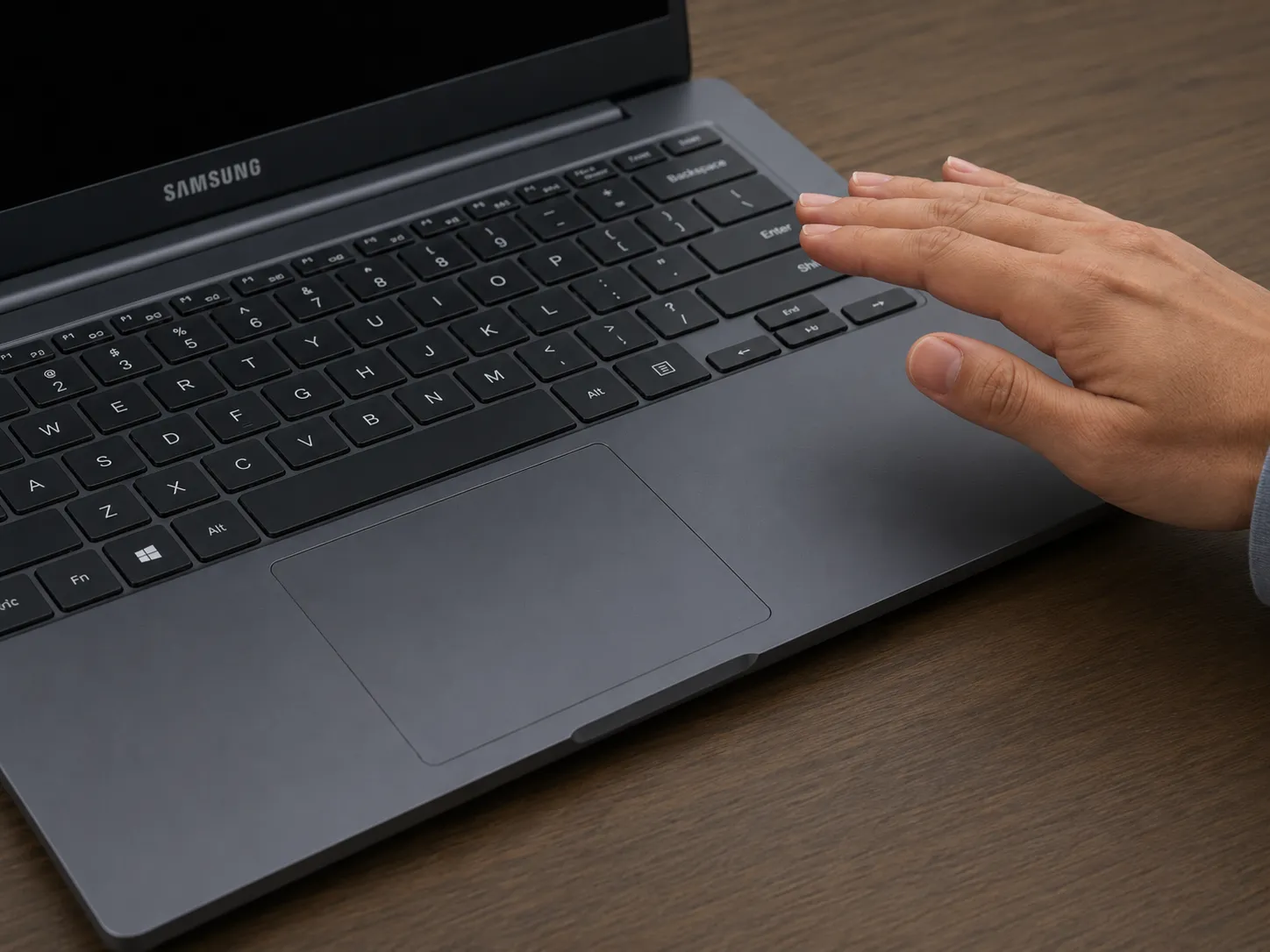
Samsung has filed a patent for a laptop concept built around a touch-sensitive palmrest that could reduce reliance on modifier keys like Ctrl, Shift, and Alt. The Samsung laptop palmrest patent describes sensors embedded in the palmrest surface that detect whether the user's hand is resting there or lifted away, then route keypresses through a different function layer depending on that state. No product has been announced, and the concept may never reach hardware, as Digital Trends and Daily Guardian UAE reported in early May 2026.
The concept turns hand position into a shortcut layer. When the laptop detects a hand on the palmrest, letter keys would behave normally. When that hand is lifted, the system could reinterpret certain keys as commands instead of text input, Digital Trends reported. In that alternate state, keys associated with common shortcuts could trigger actions such as copy, undo, or paste, while some number keys could be assigned to media or volume controls.
Patents frequently describe exploratory concepts that never ship. Digital Trends and Daily Guardian UAE both framed the idea as a patent-stage concept, and nothing in the available record suggests a product timeline.
What the Samsung laptop shortcut patent specifies and what it leaves open
The patent creates two behavioral states per key: contact mode, where keys function normally, and lifted mode, where the same keys trigger shortcuts. The transition isn't a button press or a software toggle. It's the presence or absence of the user's hand on the palmrest surface, which acts as the modifier.
The stated aim, according to the reports, is to cut down on multi-key combinations like Ctrl+C or Ctrl+Z. Instead of holding two keys simultaneously, a user would lift their hand from the palmrest and press a single key to trigger the equivalent action. That's a structural change to how shortcut input works: a sequential body-position interaction replacing a simultaneous two-finger chord.
Available coverage does not specify the sensing technology. Whether the palmrest sensors are capacitive, pressure-based, optical, or something else isn't addressed in either coverage source. Available coverage also does not explain how the system would handle the gray area between an intentional hand removal and a momentary wrist shift during normal typing. Neither gap is trivial. The sensing technology determines whether the hardware is buildable at laptop scale and price; the disambiguation question determines whether the shortcut layer fires when users want it to, rather than when they don't.
Both sources flag user adoption as a significant potential challenge if Samsung pursues the concept. Most people have strong muscle memory around modifier keys, and relearning shortcut behavior based on hand placement would require substantial adjustment, Digital Trends and Daily Guardian UAE note. That's a real hurdle, though secondary to the reliability question. People adjust to new input models when those models prove consistently better. The prior question is whether this one can be consistent enough to trust.
Research context: Samsung's approach compared to prior work on touch-sensitive palmrest input
Samsung's design isn't the first attempt to turn the physical surfaces around a keyboard into richer input channels. Two earlier projects help place it in context.
Project Mihr, published in the ACM CHI Extended Abstracts in April 2023, demonstrated a physical keyboard augmented with graphene-based capacitive fabric that could detect expressive gestural interactions layered on top of normal typing. The researchers built explicitly on "the inevitable physical touch and motions over a keyboard during keystroke-based input," treating contact that already happens as a signal worth reading.
Samsung's patent applies the same underlying logic but to a different surface and a different trigger. Project Mihr reads what hands are doing while they remain on the keyboard; Samsung's design reads whether hands are on the palmrest at all. Mihr adds a gestural vocabulary on top of an unchanged typing posture. Samsung's approach requires a deliberate postural change, lifting away from the palmrest, as the input signal itself. The design doesn't layer on top of existing behavior; it replaces part of it.
The broader research lineage on touch-sensitive input surfaces goes back further. A multi-touch tablet prototype presented at CHI in April 1985 argued that sensing multiple simultaneous contact points could expand the vocabulary of human-computer interaction well beyond single-point input. The researchers demonstrated that position, number of contact points, and degree of contact could all be read independently, opening interaction categories that a single finger or stylus couldn't reach. Samsung's patent sits in a long line of work exploring what body contact with a computing surface can mean beyond simple key actuation.
Neither historical reference makes Samsung's concept proven. They do suggest it isn't a random gimmick.
The real test: can this survive ordinary typing?
To displace Ctrl-based shortcuts, a palmrest shortcut layer needs to clear a simple three-part bar: faster, less error-prone, and easier to learn. The patent, as described in public reporting, doesn't provide data on any of the three. No user testing is mentioned, and no speed or accuracy comparisons against standard modifier-key input appear in the available record, per Digital Trends.
The failure modes are significant and specific. Accidental triggers come first: during active typing, brief palmrest contact breaks are common, a hand shifts, a wrist lifts momentarily, a user repositions. Each of those could silently fire a copy, undo, or paste command with no such action intended. Posture variability compounds the problem; the system assumes hands are either resting on the palmrest or deliberately removed, but real laptop use involves constant adjustment, especially on laps, soft surfaces, and standing desks. One-handed shortcut workflows add a third wrinkle: many Ctrl combinations are designed to work with one hand while the other operates a mouse, and the patent's model doesn't map cleanly to that scenario.
There is a user population for whom this could genuinely help. People who haven't built strong muscle memory around modifier-key combinations, newer laptop users or those who type infrequently, might find a single-key lifted interaction simpler than a two-key chord. The patent also notes that sensors need not be confined to the palmrest and could be distributed across other parts of the laptop body, Digital Trends reported. That framing suggests Samsung may be thinking about this as an input model for dual-screen or foldable devices, where a conventional palmrest doesn't exist and standard chord shortcuts lose their physical anchor. For that category, the body-position sensing approach could have stronger footing than it does on a standard clamshell. For anyone with established Ctrl-based habits, the calculus runs the other way.
What to watch for next
Samsung has identified a genuine friction point: multi-key chord shortcuts require simultaneous finger placement that some users find awkward, and that certain unconventional form factors make difficult or impossible. The palmrest-based approach is a coherent attempt to address that problem, grounded in the same research logic that produced working prototypes like Project Mihr.
What remains unanswered is whether hand position is a reliable enough signal to use as a modifier layer across the full range of postures, surfaces, and typing behaviors real users produce. The patent filing doesn't provide user testing data, accuracy figures, or false-trigger mitigation details, per Digital Trends. Those omissions are typical for a concept-stage filing, but they're also the specifics that would determine whether the system is viable.
Two developments would clarify the picture considerably. Follow-on patent filings that specify the sensing technology and describe how the system distinguishes intentional hand removal from postural variation during normal typing. And any indication from Samsung of whether the concept targets conventional Galaxy Book-class hardware or the unconventional device categories the flexible sensor placement language hints at. A dual-screen or foldable device that lacks a traditional palmrest presents a different design problem than a standard clamshell, and an input model that doesn't work well on one might work quite well on the other.
Ctrl-style copy shortcuts have been part of mainstream keyboard workflows for decades. The system competing with it needs to be reliably better, not just structurally different, to displace it.

Comments
Be the first, drop a comment!