





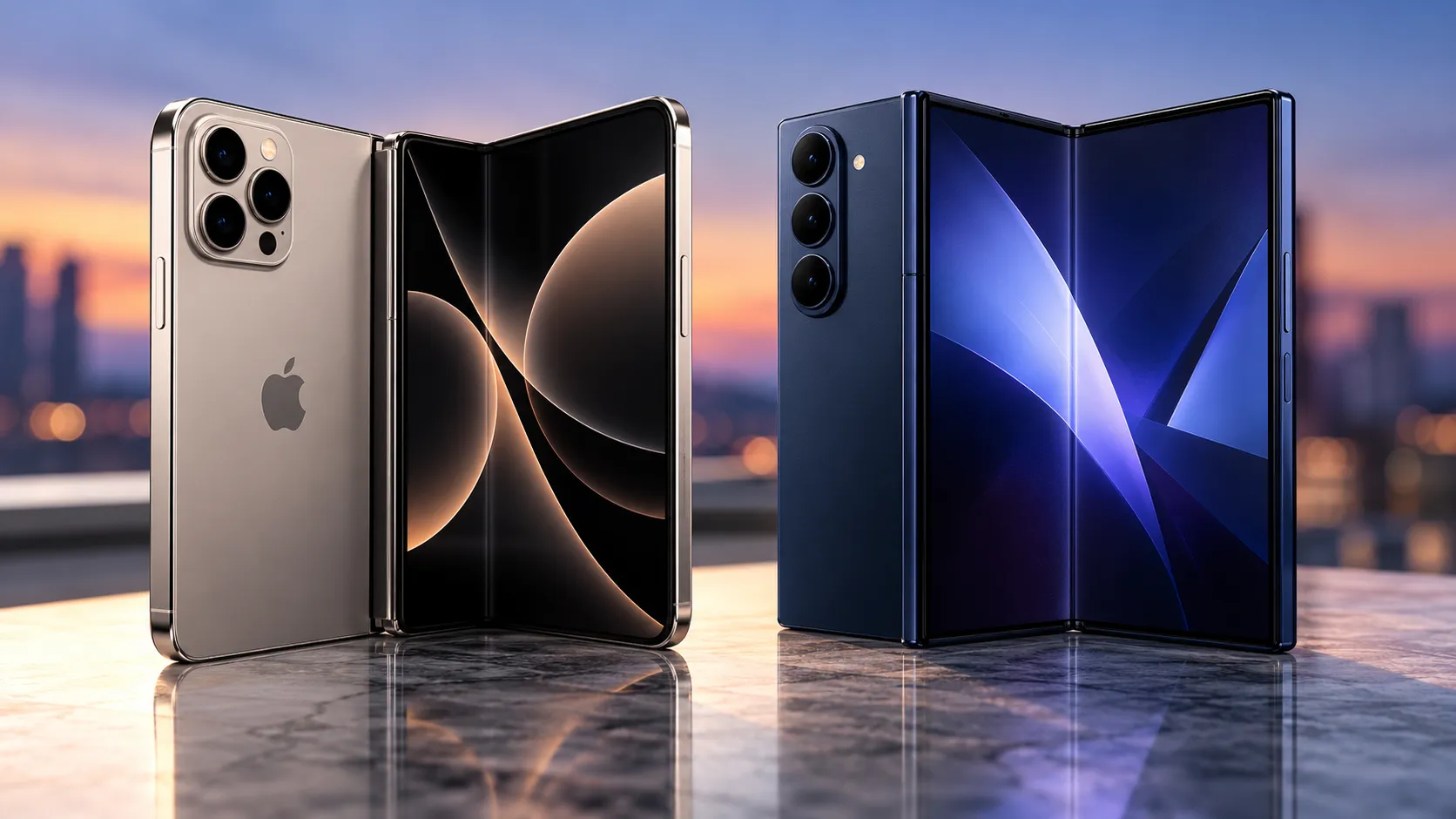
Samsung's latest foldable releases present a fascinating choice: stick with the refined evolution of the Galaxy Z Fold 7, or leap into the experimental territory of the Galaxy Z TriFold? The TriFold represents Samsung's boldest engineering achievement yet, featuring a massive 10-inch foldable display that transforms your pocket device into a tablet-sized workspace. Meanwhile, the Z Fold 7 continues perfecting the traditional book-style format with an 8-inch inner screen that's proven its durability over seven generations. The question isn't just about screen size—it's about whether you want cutting-edge innovation or battle-tested reliability in your next foldable.
Let me break down what makes each of these devices tick, because the differences reveal two fundamentally different approaches to mobile technology.
What makes the TriFold's engineering so remarkable?
The Galaxy Z TriFold pushes the boundaries of what's possible in mobile engineering, becoming Samsung's first dual-hinge foldable that manages to pack a 10-inch display into something you can still pocket. This isn't just about adding another fold—it's a complete reimagining of how foldable devices work at a fundamental level.
The engineering challenges here are genuinely mind-boggling. When unfolded, the device measures just 3.9mm at its thinnest point—that's thinner than most tablets despite housing two separate hinge mechanisms and three display panels. Samsung's team had to solve unprecedented problems with this design, starting with the asymmetric hinge approach. The right hinge is wider to accommodate the width of two stacked panels, while the left hinge mirrors the proven design from the Z Fold 7—essentially creating a hybrid system that builds on existing technology while pioneering new ground.
But here's what's really clever: the folding sequence isn't random. You need to fold the left side first, followed by the right side, and the device actually knows if you're doing it wrong. Try to close it incorrectly and it'll give you both haptic feedback and visual alerts—that's some seriously sophisticated engineering designed to prevent user error from damaging the complex mechanisms.
Perhaps most impressively, Samsung minimized the crease depth across two fold lines to the point where they're virtually invisible during normal use. They've also managed to distribute the largest battery Samsung has ever put in a foldable phone at 5,600mAh across three cells, ensuring balanced power delivery despite the complex internal architecture.
How do the displays actually compare in real-world use?
This is where the philosophical differences between these devices become crystal clear. The TriFold's 10-inch Dynamic AMOLED 2X panel that folds twice creates an entirely different user experience—one that builds on the traditional foldable concept but transforms it into something approaching a full desktop replacement. When fully opened, the TriFold can run three apps side by side, giving you the equivalent of three smartphone screens working in perfect harmony.
However, the Z Fold 7's more mature display technology reveals the trade-offs inherent in pushing boundaries this far. Its 8-inch Dynamic AMOLED 2X display delivers 2,600 nits of brightness with exceptional clarity at 368ppi pixel density—numbers that represent seven generations of refinement. The TriFold, despite its larger canvas, has a lower peak brightness level of 1,600 nits and lower pixel density of 269ppi due to the engineering compromises required for the dual-fold design.
But those compromises enable capabilities that simply aren't possible on traditional foldables. You can add more apps as pop-up windows beyond the three main panels, essentially creating a desktop-like productivity experience that scales beyond what we've seen before. Most significantly, it's the first mobile phone to have standalone Samsung DeX available, eliminating the need for external displays and creating a truly self-contained mobile workspace.
The question becomes whether you need that level of screen real estate and productivity power on a daily basis, or if the Z Fold 7's more refined, brighter, sharper 8-inch experience hits the sweet spot for most users.
What about the practical stuff—weight, durability, and daily usability?
Here's where the engineering magic meets everyday reality, and the trade-offs become impossible to ignore. The TriFold weighs 309g, making it significantly heavier than the Z Fold 7's 215g. That's nearly 50% more weight in your pocket—and when you're dealing with an already substantial device, that additional heft becomes noticeable during extended use and daily carrying.
The thickness story is equally telling. When folded, the TriFold measures 12.9mm thick compared to the Z Fold 7's more manageable 8.9mm. We're talking about a device that's pushing the boundaries of what feels comfortable as a daily driver, though the remarkable thinness when unfolded helps offset some of that bulk.
Durability ratings reveal the most significant concern for early adopters. While both devices share IP48 certification for dust and water resistance, their fold endurance tells very different stories about long-term reliability. The TriFold is rated for 200,000 folds, which Samsung calculates as about 100 folds per day for five years. That sounds reasonable until you compare it to the Galaxy Z Fold 7's 500,000 fold rating—more than double the TriFold's endurance, reflecting the inherent complexity of dual-hinge mechanisms.
Early hands-on reports also reveal some practical quirks that demonstrate this is first-generation technology. The exterior is made of a fiberglass composite that can feel sticky and attracts fingerprints, and the phone doesn't sit flat on surfaces comfortably, though Samsung includes a case to help address these issues. These are the kinds of real-world compromises that highlight the Z Fold 7's seven years of iterative refinement.
Performance, cameras, and charging: where do they stand?
Here's the reassuring news: both devices deliver absolute flagship performance where it matters most. Both are equipped with the Snapdragon 8 Elite for Galaxy processor, ensuring that your choice isn't limited by computational power. Samsung clearly wanted performance parity, allowing users to focus on form factor preferences rather than spec trade-offs.
The camera systems follow the same philosophy—both feature the same triple-lens rear camera system with a 200MP main sensor, 12MP ultrawide, and 10MP telephoto with 3x optical zoom. This decision makes sense given the TriFold's experimental nature; Samsung didn't want camera quality to become another variable in the equation.
Where they do differ significantly is in power management, which becomes crucial given their different battery demands. The TriFold supports 45W wired charging compared to the Z Fold 7's 25W wired charging. Given the TriFold's larger 5,600mAh battery versus the Z Fold 7's 4,400mAh capacity, that faster charging becomes essential for maintaining practical all-day use with the larger display's power requirements.
Storage configurations reflect Samsung's strategic positioning: The TriFold starts at 512GB and has 16GB of RAM only, while the Z Fold 7 offers more configuration variety. Both support identical connectivity standards, including Wi-Fi 7 and 5G, ensuring future-proof wireless performance regardless of your choice.
The bottom line: which foldable fits your life?
The choice between these devices ultimately comes down to your tolerance for first-generation compromises versus your need for cutting-edge capability. The Galaxy Z Fold 7 represents years of foldable refinement with proven reliability, superior durability ratings, and immediate global availability starting at $1,999. It's the smarter choice for most users right now due to its mature engineering, comprehensive ecosystem support, and real-world usability that's been refined over seven generations.
The TriFold offers something genuinely revolutionary—essentially a wide-screen tablet that folds into a phone—but comes with the inevitable trade-offs of pioneering technology. Samsung launched it on December 2nd, 2025 in Korea, with U.S. availability planned for Q1 2026 at an estimated $2,500—a premium that reflects both its innovation and limited production scale.
For most users, the Z Fold 7's combination of proven reliability, lighter weight, better durability, and superior display quality makes it the practical choice. But if you're willing to accept some compromises for the most innovative mobile display experience available, can wait for the U.S. release, and want to be part of the next evolution in mobile computing, the TriFold represents the cutting edge of what's possible when engineering constraints meet ambitious vision.
Where does foldable innovation go from here?
The TriFold and Z Fold 7 represent two distinct approaches to foldable technology: bold innovation versus proven practicality. Samsung's willingness to launch both devices simultaneously demonstrates their commitment to exploring different form factors while maintaining their successful traditional foldable line—essentially hedging their bets while pushing boundaries.
The TriFold's limited initial release strategy—shipping in very limited volume to gather real-world user insights—reveals Samsung treating this as a sophisticated testing ground for future innovations. The lessons learned from the TriFold's dual-hinge design, battery distribution, thermal management, and software optimization will likely influence not just the next generation of multi-fold devices, but all future foldables.
Meanwhile, the Z Fold 7 showcases Samsung's mastery of single-hinge design after seven generations of iteration, proving that sometimes methodical refinement creates more immediate value than revolutionary leaps. The competition between these philosophies—and pressure from Chinese manufacturers like Huawei—will ultimately accelerate innovation across the entire category, giving consumers better options regardless of which approach proves most successful in the long term.


Comments
Be the first, drop a comment!